
By OTechHub Editorial Team. Educational content only; this article is not medical advice.
Neurotický is a Czech and Slovak adjective that translates into English as “neurotic.” It is generally used to describe someone or something associated with excessive worry, anxiety, nervousness or emotional reactivity. The word can appear in everyday conversations, written descriptions and psychological discussions.
People searching for neurotický usually want to understand its English translation or discover what the related term neuroticism means in psychology. Although these words are connected, they are not interchangeable.
The important distinction is that neurotic is a descriptive adjective, while neuroticism is a personality dimension studied in psychology. Neither word, by itself, establishes that someone has a mental disorder.
This guide explains the translation, grammar, pronunciation, everyday usage and psychological meaning of the term.
What Does Neurotický Mean in English?
The standard English translation of neurotický is neurotic.
It is an adjective used to describe a person, behaviour, reaction or tendency associated with anxiety, excessive concern or emotional distress.
The word appears in both Czech and Slovak. The Slovak Short Dictionary lists neurotický as an adjective, while Czech-English vocabulary references also give neurotický as the translation of neurotic.
The meaning can vary slightly depending on context.
For example:
- Everyday conversation: Describing someone who worries excessively about relatively small matters.
- Personality psychology: Discussing characteristics associated with neuroticism.
- Historical psychological writing: Referring to terminology connected with neurosis or older classifications of psychological conditions.
Simple translation examples
| Czech or Slovak | English translation |
|---|---|
| neurotický člověk | neurotic person |
| neurotické chování | neurotic behaviour |
| neurotický strach | neurotic fear |
| neurotické tendencie | neurotic tendencies |
| neurotický stav | neurotic state |
The adjective changes its ending according to grammatical gender, number and case.
For example, Czech uses neurotický in the masculine form, neurotická in the feminine form and neurotické in the neuter form. Slovak also uses grammatical agreement, although individual forms should be checked against the relevant language rules.
For additional verification, consult the Slovak Short Dictionary.
Neurotický Pronunciation and English Translation
The English equivalent, neurotic, has different British and American pronunciations.
According to Cambridge Dictionary:
- British English: /njʊəˈrɒt.ɪk/
- American English: /nʊˈrɑː.t̬ɪk/
The main stress falls on the second syllable.
You can listen to both versions using the Cambridge Dictionary pronunciation guide.
When translating the Czech or Slovak word, it is generally better to consider the complete sentence rather than relying on an isolated dictionary definition.
For example:
- Je trochu neurotický, když jde o termíny. — He is a little neurotic when it comes to deadlines.
- Článok opisuje neurotické správanie. — The article describes neurotic behaviour.
These examples illustrate ordinary usage rather than clinical descriptions.
What Does Neurotic Mean in Psychology?
In everyday English, neurotic is commonly used to describe someone who appears excessively worried, nervous or emotionally reactive.
In psychology, however, the related concept of neuroticism has a more specific meaning.
It describes a personality dimension associated with a tendency to experience negative emotional states, including:
- Anxiety and nervousness.
- Sadness and low mood.
- Irritability and anger.
- Embarrassment and self-consciousness.
- Greater sensitivity to stressful situations.
The American Psychological Association’s Dictionary of Psychology describes neuroticism as a dimension of the five-factor personality model associated with emotional instability and psychological distress.
The National Library of Medicine’s Medical Subject Headings (MeSH) also defines neuroticism as a personality trait involving negative emotional responses to threats, frustration or loss.
An important distinction is that experiencing these emotions occasionally is a normal part of human life. The concept concerns differences in how frequently and intensely people tend to experience them.
What Is Neuroticism in the Big Five Personality Model?
Neuroticism is one of the five dimensions in the Big Five personality model, a widely studied framework for describing differences in human personality.
The five dimensions are:
| Personality dimension | What it describes |
|---|---|
| Openness | Curiosity, imagination and interest in new experiences |
| Conscientiousness | Organisation, responsibility and self-discipline |
| Extraversion | Sociability, energy and engagement with others |
| Agreeableness | Cooperation, consideration and interpersonal behaviour |
| Neuroticism | Tendency to experience negative emotions and psychological distress |
These dimensions describe different aspects of personality. They are not categories that divide people into five fixed personality types.
Neuroticism is generally understood as a spectrum. People can have relatively higher or lower levels of this trait.
The opposite direction is commonly described as emotional stability. People with lower neuroticism generally report less frequent or less intense negative emotional experiences.
This does not mean that emotionally stable individuals never experience anxiety, sadness or stress.
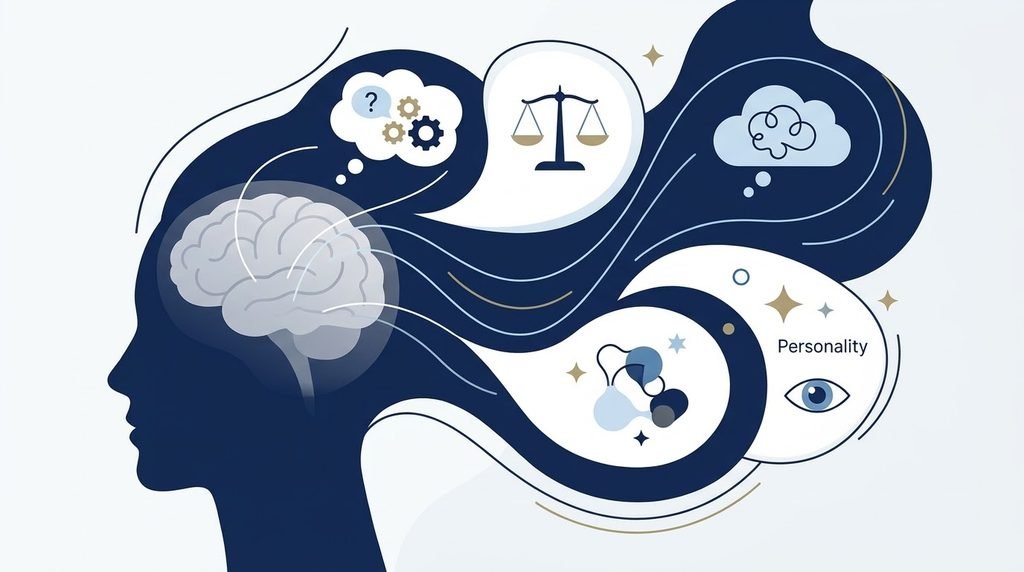
Common Examples of Neurotic Behaviour
The phrase neurotic behaviour is often used in everyday communication to describe patterns of excessive worry, repeated self-doubt or strong emotional reactions.
The following examples are illustrative. They are not clinical diagnostic criteria.
1. Excessive Worry About Small Mistakes
Someone sends an ordinary work email and then rereads it repeatedly, worrying that a small grammatical error could damage their professional reputation.
The concern continues even after the message has been checked.
2. Repeated Self-Doubt
A student prepares carefully for an examination but continues questioning whether they have studied enough.
Even after receiving positive feedback, they struggle to feel confident about their preparation.
3. Strong Emotional Reactions
A minor change in plans causes someone to experience frustration or distress that lasts much longer than expected.
The reaction may seem disproportionate to the situation.
4. Constantly Expecting Negative Outcomes
Before travelling, a person repeatedly imagines possible problems, such as missing a flight, losing luggage or arriving late.
They find it difficult to relax even after making reasonable preparations.
5. Repeatedly Seeking Reassurance
Someone repeatedly asks friends whether they said something inappropriate during a conversation.
Even after receiving reassurance, they continue worrying about the interaction.
These situations can happen to anyone, particularly during stressful periods. Their presence alone does not establish a personality trait or mental health condition.
Frequency, intensity, personal circumstances and effects on everyday life all matter.
Neurotic vs Neuroticism vs Neurosis: What Is the Difference?
These three terms are closely related in language and history, but they have different meanings.
| Term | Meaning | Common context |
|---|---|---|
| Neurotic | An adjective describing a person, reaction or behaviour | Everyday language and psychological descriptions |
| Neuroticism | A personality dimension associated with negative emotional experiences | Personality psychology |
| Neurosis | A historical psychological term used for different forms of psychological distress | History of psychology and older clinical terminology |
What Does Neurosis Mean?
Neurosis is a historical term that was previously used as a broad label for certain psychological difficulties, particularly those associated with anxiety and distress.
Its meaning changed across different psychological traditions and periods.
Modern diagnostic systems use more specific classifications rather than treating neurosis as one broad diagnostic category.
For example, the World Health Organization’s ICD-10 included a category called neurotic, stress-related and somatoform disorders.
In ICD-11, these conditions are organised into more specific diagnostic groupings, including anxiety or fear-related disorders, obsessive-compulsive and related disorders, and disorders specifically associated with stress.
You can consult the WHO’s ICD-11 Clinical Descriptions and Diagnostic Requirements for the modern classification.
Neurotic vs Anxious: What Is the Difference?
The words neurotic and anxious are related, but they do not mean exactly the same thing.
Anxious usually describes a feeling or emotional state. It can be temporary and connected to a particular situation.
Neurotic can describe a broader tendency towards excessive worry or emotional reactivity.
Consider these examples:
Example 1: Temporary anxiety
Maya feels anxious before a job interview. Once the interview finishes, she relaxes and returns to her normal routine.
Example 2: A broader tendency
Daniel frequently worries about mistakes at work, possible problems during travel and everyday interactions, even when there is no obvious reason for concern.
The second example illustrates a pattern that could be associated with higher neuroticism.
However, these descriptions are not enough to determine someone’s personality profile or diagnose a condition.
Is Neuroticism a Mental Illness?
No. Neuroticism alone is not a mental illness or a psychiatric diagnosis.
It is a personality dimension used to describe individual differences in emotional experiences.
People with higher neuroticism may experience negative emotions more frequently or intensely, but this does not automatically mean they have an anxiety disorder or depression.
What Does Scientific Research Say?
Research has examined the relationship between neuroticism, anxiety and depressive disorders.
A longitudinal study published in Anxiety, Stress, and Coping examined 489 university students over six years.
The researchers found that higher baseline neuroticism was associated with the first onset of several conditions, including panic disorder, agoraphobia, generalised anxiety disorder and major depressive disorder.
The study also found that some participants who developed these conditions experienced increases in neuroticism scores.
Importantly, the researchers concluded that high neuroticism could be a risk factor or a marker of risk. Their findings do not establish that neuroticism alone causes mental illness.
Read the original research: A Longitudinal Study of Personality Traits, Anxiety, and Depressive Disorders in Young Adults.
The practical takeaway is that personality traits and mental health conditions are related research topics, but they should not be treated as identical.
When Should Someone Seek Professional Support?
If worry, anxiety or emotional distress becomes persistent and starts interfering with sleep, work, education, relationships or other important activities, speaking with a qualified mental health professional may be helpful.
A professional can assess the symptoms and determine whether further support is appropriate.
This article is educational information, not a diagnostic tool.
What Is the Opposite of Neurotic?
In personality psychology, the opposite direction of neuroticism is commonly described as emotional stability.
People with relatively lower neuroticism tend to experience fewer or less intense negative emotional reactions and may recover more easily from stressful situations.
Other words that can describe this direction in everyday English include:
- Calm.
- Composed.
- Relaxed.
- Emotionally balanced.
- Even-tempered.
- Resilient.
However, emotional stability does not mean someone never feels worried, nervous or upset.
Personality is complex, and people can respond differently depending on their circumstances.
How to Use Neurotic in Everyday English
Neurotic is an adjective. It can appear before a noun or after a linking verb.
Common grammatical patterns
Neurotic + noun
- Neurotic behaviour.
- Neurotic fear.
- Neurotic tendencies.
- Neurotic reactions.
- Neurotic personality traits.
Subject + be + neurotic
- He is neurotic about money.
- She is neurotic about cleanliness.
Become + neurotic
- He became neurotic about making mistakes.
Example sentences
- She became neurotic about checking the front door before leaving.
- He is sometimes neurotic about missing important appointments.
- The character displays several neurotic tendencies throughout the film.
- His neurotic fear of failure makes simple decisions difficult.
- She worries excessively about small details.
- The article explains neuroticism as a personality dimension.
- Calling someone neurotic can sound judgmental.
- He tends to become nervous before important presentations.
- Her repeated concern about minor mistakes affects her concentration.
- The researcher examined the relationship between neuroticism and anxiety.
More Neutral Alternatives to Neurotic
Although neurotic is a legitimate English word, it can sound critical when used to describe another person.
Depending on the intended meaning, these alternatives may be more appropriate:
| Alternative | When to use it |
|---|---|
| Anxious | Describing a feeling of worry or unease |
| Worried | Describing concern about a particular issue |
| Nervous | Describing temporary tension or apprehension |
| Emotionally reactive | Describing strong emotional responses |
| Highly concerned | Describing significant attention to a problem |
| Prone to worry | Describing a recurring tendency to worry |
For example, instead of saying, “She is neurotic,” a more neutral sentence would be:
“She frequently worries about everyday situations.”
The second description communicates the behaviour without unnecessarily labelling the person.
Is Neurotic the Same as Nervous or Psychotic?
No. These words have different meanings.
Neurotic vs Nervous
Nervous generally describes temporary tension, apprehension or worry.
For example:
“I feel nervous before my examination.”
This is a normal description of a temporary emotional state.
Neurotic generally suggests a stronger pattern of excessive worry or emotional reactivity.
Neurotic vs Psychotic
These terms should never be confused.
Neurotic is associated with worry, anxiety and emotional distress in everyday usage.
Psychotic relates to psychosis, which can involve symptoms such as hallucinations or delusions.
They describe different psychological concepts and are not interchangeable.
How to Understand Neurotický When Translating a Sentence
When translating neurotický from Czech or Slovak into English, consider three things.
1. Identify the grammatical role.
Determine whether the word describes a person, behaviour, fear or another noun.
2. Understand the surrounding sentence.
The intended meaning may be informal, descriptive or connected to psychological terminology.
3. Choose the appropriate English expression.
Although neurotic is the standard equivalent, a different word such as anxious, worried or emotionally reactive may communicate the meaning more naturally in some sentences.
This approach is especially important when translating academic, medical or professional material.
Readers researching unfamiliar online words can also explore OTechHub’s guides to Harouxinn’s meaning and online interpretations and Comerlin’s meaning and documented origin. Both illustrate why context and reliable evidence matter when interpreting unfamiliar terms.
Frequently Asked Questions About Neurotický
1. What does Neurotický mean in English?
Neurotický translates into English as neurotic. It is an adjective associated with excessive worry, anxiety or emotional reactivity.
2. Is Neurotický a Czech or Slovak word?
It is used in both Czech and Slovak. The base spelling is the same, although grammatical forms change according to the language’s rules.
3. How do you pronounce neurotic?
In British English, the pronunciation is approximately /njʊəˈrɒt.ɪk/. In American English, it is approximately /nʊˈrɑː.t̬ɪk/.
4. What does neurotic mean in psychology?
In everyday psychological descriptions, neurotic refers to tendencies involving worry, anxiety or emotional reactivity. The related scientific term neuroticism describes a personality dimension associated with negative emotional experiences.
5. What is neuroticism?
Neuroticism is one of the five dimensions in the Big Five personality model. It describes individual differences in the tendency to experience negative emotions and psychological distress.
6. Is neuroticism a mental illness?
No. Neuroticism is a personality dimension, not a mental illness or diagnosis by itself.
7. What is the difference between neurotic and anxious?
Anxious usually describes an emotional state, while neurotic can describe a broader tendency towards excessive worry or emotional reactivity.
8. What is the opposite of neurotic?
Emotional stability is commonly used to describe the opposite direction of neuroticism.
9. Can someone have neurotic tendencies without a mental disorder?
Yes. A person can experience higher neuroticism or frequent worry without meeting the diagnostic criteria for a mental disorder.
10. Is neurotic the same as psychotic?
No. Neurotic is associated with worry and emotional distress, while psychotic relates to psychosis, which can involve hallucinations or delusions.
Final Thoughts
Neurotický is the Czech and Slovak equivalent of the English adjective neurotic. It is commonly used to describe excessive worry, nervousness or emotional reactivity, although its precise meaning depends on the sentence and context.
In psychology, the related term neuroticism describes a personality dimension associated with negative emotional experiences. It is one of the Big Five personality dimensions and is not, by itself, a mental illness.
Understanding the differences between neurotic, neuroticism and neurosis makes translation more accurate and helps prevent unnecessary confusion when discussing personality or mental health.
The most important point is simple: a descriptive word should not be treated as a medical diagnosis, and a personality trait does not define a person’s entire identity.
Editorial note: This article is intended for general educational and language-learning purposes. It does not replace professional psychological assessment or medical advice.
