Introduction
Comerlin is an uncommon name that raises several questions for people encountering it online. Is it a surname? Does it have a historical meaning? Where did it originate? And is it connected to Kömmerling, the established German brand associated with window and building systems?
The available evidence provides some useful answers, but it also reveals important limitations. Comerlin appears in genealogy databases as a surname, including historical entries associated with France and an Austrian parish-register index. However, its precise linguistic meaning and original geographical origin have not been conclusively established.
Kömmerling, by contrast, has a documented business history dating back to 1897. Although the two names look somewhat similar, no verified evidence establishes a family, historical or commercial connection between them.
This guide examines the available records, explains the difference between the two names and shows how to investigate an unfamiliar surname using reliable historical sources.
What Is Comerlin?
Comerlin is an uncommon name documented in genealogy databases as a surname. It is not currently supported by sufficient linguistic or historical evidence to assign it a definitive meaning.
The spelling is important because several similar-looking names can appear in online searches. Comerlin should not automatically be treated as an alternative spelling of another surname or company name.
Genealogy databases provide one useful starting point. They collect historical references, family-tree information and archival indexes that help researchers investigate names across different periods.
For Comerlin, these records provide evidence that the name has been used by individuals in historical documents. However, they do not establish a complete family history or explain how the surname originally developed.
The name should therefore be understood in the context in which it appears:
- In a family tree, Comerlin may identify an individual or family surname.
- In a historical document, it may represent an original spelling or a transcription.
- In an online search, it may be confused with a similar company or brand name.
- In a business document, its meaning should be checked against the original organization or product information.
Understanding the context is the first step toward identifying what Comerlin actually refers to.
Does Comerlin Have a Verified Meaning or Origin?
There is currently no sufficiently established etymological explanation for the surname Comerlin.
A surname’s appearance in historical records does not automatically reveal its original meaning. Researchers must distinguish between evidence of name usage and evidence of linguistic origin.
For example, a historical document might establish that someone used a particular surname in the nineteenth century. It would not necessarily explain whether that name originally came from a geographical location, occupation, personal characteristic or another language.
A reliable surname-origin investigation generally requires several types of evidence.
Historical spelling records: Older documents can reveal how a name was written in different periods. These variations may provide clues about changes in spelling and pronunciation.
Geographical distribution: Records showing where a surname appears can help researchers identify areas worth investigating. However, present-day database distributions do not necessarily identify the original birthplace of a surname.
Language and etymology: Specialists in onomastics, the study of personal and place names, examine linguistic patterns and historical usage to investigate possible meanings.
Family documentation: Birth certificates, marriage records, church registers and other original documents can help establish relationships between individuals.
Historical continuity: Multiple records connecting individuals across generations provide stronger evidence than isolated database entries.
Until this evidence is available, claims that Comerlin has a confirmed French, German, Irish or other linguistic origin should be treated cautiously.
The most accurate conclusion is that Comerlin is a documented surname whose precise origin and meaning remain uncertain.
Comerlin Surname: What Historical Records Reveal
One useful starting point is the Geneanet Comerlin surname database.
Geneanet identifies Comerlin as an uncommon surname and provides historical references that can help researchers investigate its usage.
Some of the visible entries include:
| Historical entry | Available information | Research limitation |
|---|---|---|
| Marie Comerlin | Birth in 1803, death in 1882 and a spouse reference to Jean Darfeuille dated 1827 | Parentage and complete family history are not established by the listing |
| Françoise Comerlin | A reference to Pierre Desgraupes in 1856 | Her relationship to other Comerlin entries is unverified |
| Cömerlin Elisabetha | An entry associated with parish-register material from St. Pölten, Lower Austria | The original spelling and family relationship require further investigation |
These records are useful because they show that Comerlin and a similar spelling appear in historical genealogical material.
However, they should not be interpreted as proof that all the individuals belonged to one family.
There is also a geographical dimension to the research. Geneanet’s current index shows Comerlin entries associated with several French locations, including Saint-Jean-de-Côle and Milhac-de-Nontron in Dordogne, as well as locations in other parts of France.
These locations describe the distribution of records within Geneanet’s database. They do not prove that the surname originated in Dordogne or that every person carrying the name shares the same ancestry.
Another important distinction concerns the spelling Cömerlin. An umlaut can influence how a name is written, indexed or searched. Its appearance in a historical record does not automatically establish that it is an ancestral variant of every Comerlin family.
The best approach is to treat each entry as a research lead and look for the original document.
How to Verify the Historical Comerlin Records
A genealogy index can make research easier, but original historical records provide stronger evidence.
For example, if a database identifies an individual named Marie Comerlin with a birth year of 1803, a researcher can use that information to look for a corresponding civil registration or church record.
The verification process should involve:
- Recording the individual’s full name and available dates.
- Identifying the town or region associated with the entry.
- Searching for an original birth, baptism or marriage document.
- Checking the names of parents, spouses and witnesses.
- Comparing the spelling across multiple records.
- Recording the source and any remaining uncertainties.
This process helps reduce the risk of connecting two unrelated people simply because they share a surname.
Historical records may contain spelling variations, handwriting errors and incomplete information. These limitations make careful verification especially important when researching uncommon names.
Is Comerlin Related to Kömmerling?
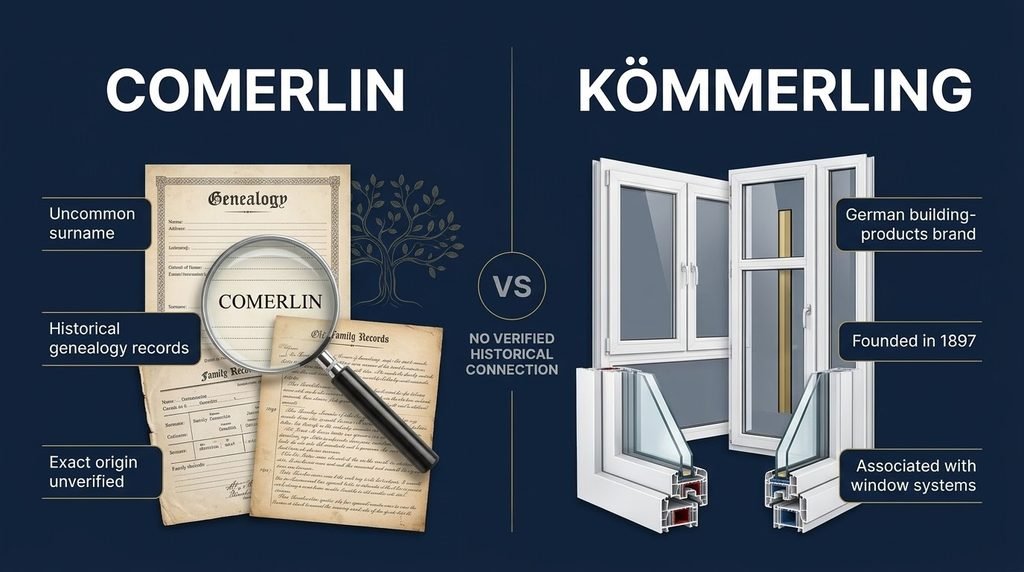
There is no verified evidence establishing a connection between Comerlin and Kömmerling.
The names have some visual similarities, but their spellings are different.
Kömmerling contains an initial K, an umlaut over the letter o, a double m and an ending in -ling. Comerlin begins with C, uses a standard o, contains one m and ends in -lin.
These differences matter when identifying a person, business or product.
Search-engine suggestions can also contribute to confusion. Someone who remembers the sound of a name but not its exact spelling may search for Comerlin when the original reference was actually Kömmerling.
The umlaut creates another possible source of confusion. In German-language digital writing, the letter ö is sometimes represented as oe. This means Kömmerling may also appear as Koemmerling in websites and other digital records.
However, the spelling difference is not evidence of a relationship between the two names.
A connection would require supporting historical documents, such as family records establishing a shared lineage or corporate documentation demonstrating a business relationship. The sources reviewed for this article do not establish either.
For this reason, Comerlin and Kömmerling should be researched as separate subjects.
What Is Kömmerling Known For?
Kömmerling is a documented German brand with a long history in the building-products industry.
According to profine Group’s official company history, the company Kömmerling was founded in 1897 in Pirmasens, Germany, by Karl Kömmerling.
The company’s history is part of a wider development in the European plastics and building-materials industries.
Several important milestones help explain its background:
| Year | Historical development |
|---|---|
| 1897 | Kömmerling was founded in Pirmasens by Karl Kömmerling |
| 2000 | HT TROPLAST acquired Kömmerling Kunststoffe |
| 2003 | profine GmbH was established by consolidating profile-related business activities |
| 2020 | The Kömmerling Better World Stiftung was established |
| 2022 | The Kömmerling brand marked its 125th anniversary |
| 2024 | profine expanded its portfolio through the acquisition of EFP International B.V. |
Today, the Kömmerling brand is associated with window and door systems and PVC-U profile solutions.
The wider profine Group describes itself as a manufacturer of PVC-U profiles for windows and doors and a provider of shutter systems, PVC sheets and other profile-related solutions.
Its products serve construction and building applications where window frames, doors and related components are required.
The official Kömmerling brand information provides further information about the brand and its product identity.
It is important to distinguish the brand’s documented history from the Comerlin surname records. The existence of a company named Kömmerling does not establish that Comerlin is connected to its founder, ownership or commercial activities.
Comerlin vs. Kömmerling: Key Differences
Although the names may appear similar in search results, the available evidence points to two different subjects.
| Comparison | Comerlin | Kömmerling |
|---|---|---|
| Exact spelling | Comerlin | Kömmerling |
| Name category | Surname in genealogy records | Established commercial brand |
| Historical evidence | Genealogy database entries | Documented company history |
| Origin | Not conclusively established | Founded in Pirmasens, Germany |
| Meaning | No verified linguistic meaning | Named after founder Karl Kömmerling |
| Industry | No established industry association | Building products and window systems |
| Verification | Historical family and civil records | Official profine documentation |
The main difference is the type of evidence available.
Comerlin is primarily investigated through genealogy and surname records. Kömmerling can be investigated through official company history and product documentation.
The distinction is useful when checking unfamiliar names online. A small spelling difference can lead to entirely different search results, so it is important to verify the original spelling before accepting an explanation.
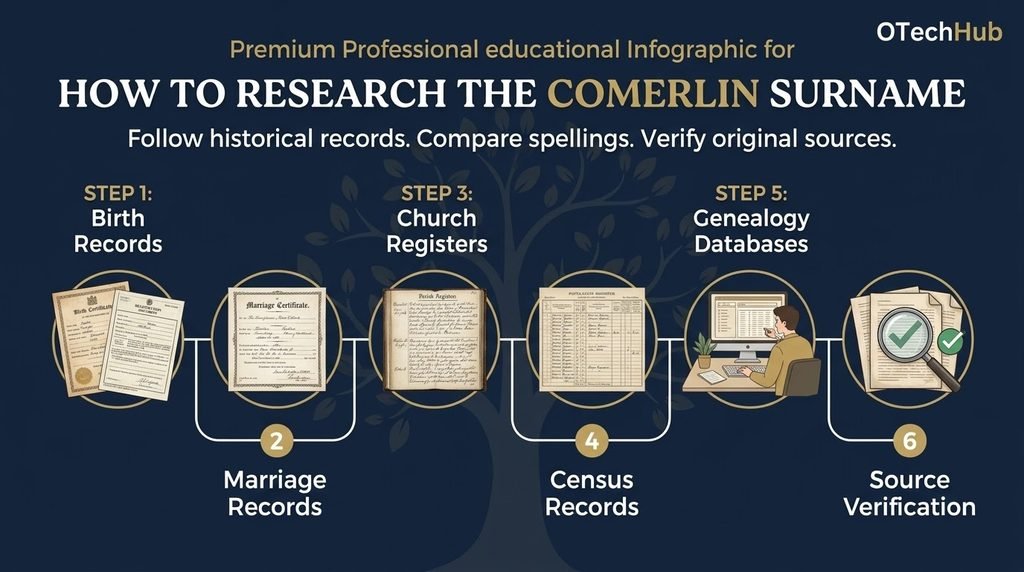
How to Research the Comerlin Surname
People investigating a possible Comerlin family connection should begin with information they already know.
A family member’s name, approximate birth year or historical location can provide a starting point for finding relevant documents.
The following resources are particularly useful.
1. Birth and baptism records
Birth certificates and baptism registers can provide an individual’s date of birth, parents’ names and location.
These documents are often useful when establishing the earliest known generations of a family.
2. Marriage records
Marriage documents can connect two family names and provide additional details about parents, witnesses and places of residence.
They can help researchers distinguish between people with similar names.
3. Death and burial records
Death certificates and burial registers may contain ages, dates and family information.
When combined with birth records, they can help establish whether two historical references concern the same individual.
4. Church registers
Historical church records are especially valuable when civil registration documents are unavailable.
Baptism, marriage and burial registers may contain information from periods before modern government record systems existed.
5. Census and population records
Census documents can show household members, approximate ages, occupations and residential locations.
They may help establish connections between generations, although the availability and detail of census records vary by country.
6. Immigration documents
Passenger lists, naturalization records and other migration documents can help researchers follow families who moved between countries.
They may also explain why a surname appears with different spellings in different locations.
7. Genealogy databases and archives
Genealogy websites can help identify possible family connections and locate historical references.
Geneanet is a useful starting point for examining Comerlin entries.
FamilySearch provides access to historical record collections and genealogy research tools.
Neither platform should replace verification against original documents when those documents are available.
Tips for Investigating Uncommon Surnames
When researching Comerlin, consider these practical steps:
- Search the exact spelling before trying variations.
- Check whether the original document uses an accent or special character.
- Compare dates and locations instead of relying on names alone.
- Keep a record of the sources used.
- Avoid assuming that two individuals are related without supporting evidence.
- Look for original documents rather than relying entirely on copied family-tree entries.
- Record uncertain information separately from verified findings.
These methods are useful for researching other uncommon surnames as well.
Why Unfamiliar Names Are Often Misunderstood Online
An unfamiliar word can become difficult to identify when different websites use similar spellings or provide incomplete explanations.
Several factors contribute to this problem.
Spelling differences: A single changed letter can produce a different surname or business name.
Missing accents: Names containing special characters may appear differently when entered into search engines, databases or older digital systems.
Search-engine suggestions: Search engines may display related terms based on popularity and previous searches. These suggestions are not proof that two names share an origin.
Phonetic searches: People sometimes search using the sound of a name instead of its exact spelling. This can lead to unrelated results.
Repetition of unsupported claims: When one website publishes an uncertain explanation, other websites may repeat it without checking the original evidence.
For example, someone who sees the Kömmerling name on a window profile might later search for Comerlin after forgetting the exact spelling. The results could include both surname records and company information.
The correct response is to return to the original context and verify the spelling.
This is also why online research should involve comparing multiple sources instead of relying on the first result.
Common Misconceptions About Comerlin
Several assumptions about Comerlin should be avoided unless stronger evidence becomes available.
1. Comerlin is a major commercial brand
The genealogy sources examined for this article identify Comerlin as a surname. They do not establish it as a major commercial brand or manufacturer.
2. Comerlin and Kömmerling are the same company
No verified evidence supports this claim. Kömmerling has its own documented company and brand history.
3. Comerlin has a confirmed linguistic origin
Its exact etymology has not been established through the sources reviewed. Assigning a specific language or nationality would go beyond the available evidence.
4. Everyone with the Comerlin surname belongs to one family
This cannot be established from a few genealogy entries. Shared surnames do not automatically prove common ancestry.
5. A genealogy database proves an entire family history
A database entry is a research lead. It should be checked against the underlying historical document whenever possible.
6. Similar spelling means two names share the same origin
Names can resemble each other by coincidence. Historical, linguistic or documentary evidence is needed before suggesting a relationship.
Frequently Asked Questions About Comerlin
1. What does Comerlin mean?
No definitive linguistic meaning has been established. Comerlin appears in genealogy databases as an uncommon surname, but its original meaning remains uncertain.
2. Is Comerlin a real surname?
Yes. Genealogy databases such as Geneanet contain historical entries using the Comerlin spelling, including references to individuals such as Marie Comerlin and Françoise Comerlin.
3. Where does the Comerlin surname originate?
Its original geographical origin has not been conclusively established. Genealogy records show references associated with French locations and an Austrian parish-register index, but these do not prove where the surname began.
4. Is Comerlin related to Kömmerling?
No verified connection has been established. The names have different spellings and are supported by different types of historical evidence.
5. Who founded Kömmerling?
According to profine Group, Karl Kömmerling founded the company in 1897 in Pirmasens, Germany.
6. What products does Kömmerling manufacture?
The Kömmerling brand is associated with window and door systems and PVC-U profiles. The wider profine Group also supplies shutter systems, PVC sheets and other building-related products.
7. How can I research the Comerlin family name?
Start with known relatives and search historical birth, marriage, death and church records. Geneanet and FamilySearch can help locate possible records, but original documents should be checked wherever available.
8. How can I distinguish Comerlin from Kömmerling?
Check the exact spelling and the original context. Comerlin appears in surname records, whereas Kömmerling is a documented building-products brand. Do not assume that the two names are interchangeable.
Final Thoughts: What the Evidence Actually Tells Us About Comerlin
Comerlin is an uncommon surname that appears in historical genealogy databases, but its exact linguistic meaning and original geographical origin remain uncertain.
The available records provide useful research leads, including references to Marie Comerlin, Françoise Comerlin and Cömerlin Elisabetha. They also show geographical references associated with several French locations and historical parish material from Lower Austria.
However, these entries do not establish a single family history or prove a specific national origin.
Kömmerling is a separate and well-documented subject. Founded by Karl Kömmerling in Pirmasens in 1897, it developed into an established name in the building-products industry and is now associated with profine Group.
For anyone researching Comerlin, the most reliable approach is to verify the exact spelling, examine the original historical context and compare multiple independent records. A database entry can provide a valuable starting point, but reliable conclusions require supporting evidence.
Ultimately, understanding Comerlin means recognizing the difference between what historical records actually show and what remains unproven. That distinction makes surname research more accurate and helps prevent unrelated names from being mistakenly connected.
