Introduction
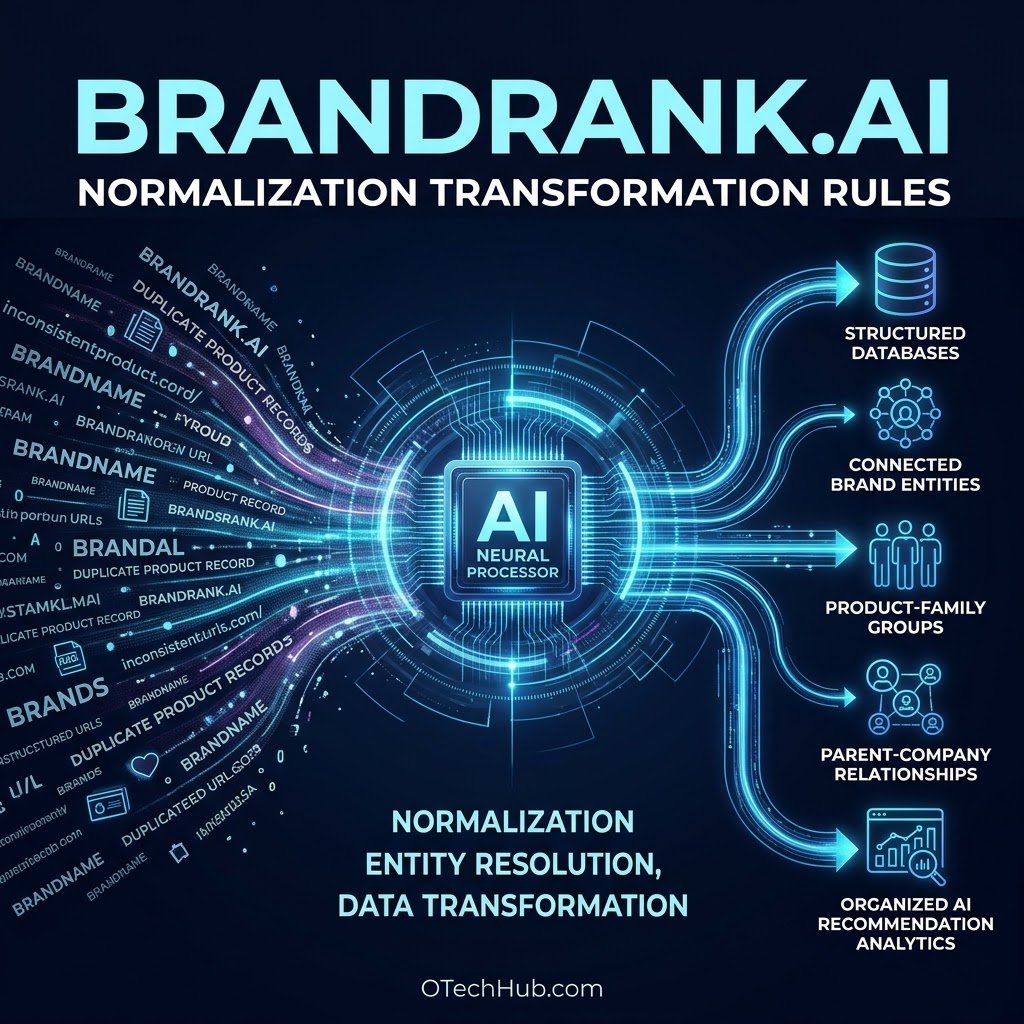
BrandRank.ai normalization transformation rules explain an important part of how AI-generated brand recommendations can be organized, compared, and measured. Rather than treating every brand mention as an independent record, normalization helps connect different product names, variations, and company identities to consistent entities.
This process becomes particularly important when multiple AI answer engines recommend products from the same company using different brand or product names.
BrandRank.AI provides a practical example through its published AI Recommendation Share research methodology. Its Research Hub documents a normalization stage that groups product names by product family for consensus analysis and by parent company for Recommendation Share calculations.
For example, Kindle, Fire HD, and Ring can contribute to Amazon’s parent-company Recommendation Share. This demonstrates why entity relationships matter when measuring how AI platforms represent brands. BrandRank.AI Research Hub.
Understanding this methodology requires looking beyond simple name standardization. Product-family mapping, parent-company relationships, duplicate detection, and validation all contribute to accurate brand intelligence.
This guide examines BrandRank.ai’s documented normalization methodology, explains the underlying technical concepts, and provides practical examples of how organizations can apply similar principles when analyzing AI-generated recommendations.
What Are BrandRank.ai Normalization Transformation Rules?
Normalization is the process of organizing different representations of information into a consistent structure without losing their underlying meaning.
In AI brand intelligence, this can involve identifying when different product names belong to the same product family or when multiple brands are owned by the same parent company.
BrandRank.AI publicly documents this process in its Recommendation Share Index methodology.
Its research describes two important normalization levels:
Product-family normalization: Different product generations or variations are grouped into a common product family when measuring agreement between AI engines.
Parent-company normalization: Different brands and products are associated with their parent company when calculating company-level Recommendation Share.
These approaches answer two different questions:
- Which products or product families are AI engines recommending?
- Which companies are receiving those recommendations?
This distinction is important because product-level recommendations and company-level performance are not necessarily the same measurement.
The documented methodology relates specifically to BrandRank.AI’s published research indexes. It should not be confused with an independently documented universal normalization algorithm or a complete technical specification of its internal platform.
Why Normalization Matters in AI Brand Intelligence
AI answer engines do not always use identical names when discussing products and businesses.
One platform might recommend a specific product generation, while another might mention the broader product family. Similarly, an AI-generated answer might recommend a subsidiary brand without explicitly naming its parent company.
Without a consistent classification method, comparing these responses can produce misleading results.
Consider a hypothetical example involving a technology company:
| AI-generated reference | Relevant identity |
|---|---|
| Product Alpha 2 | Alpha product family |
| Product Alpha 3 | Alpha product family |
| Alpha subsidiary | Parent company Alpha Group |
| Alpha official store | Verified business entity |
A normalization process connects the relevant records while retaining their original names.
This is useful for:
- Comparing AI recommendations across platforms.
- Identifying product-family popularity.
- Measuring parent-company recommendation performance.
- Avoiding duplicate brand records.
- Tracking competitor positioning.
- Understanding changes in AI-generated brand representation.
Normalization does not automatically make AI answers more accurate. Its purpose is to make the analysis of those answers more consistent and transparent.
How BrandRank.ai Normalizes Brand and Product Information
BrandRank.AI’s published Research Hub describes a four-stage research methodology: Ask, Answer, Normalize, and Check.
The normalization stage is particularly important because it determines how different recommendations are grouped before reporting.
1. Ask: Establish Consistent Questions
The research begins by asking AI answer engines the same questions under an identical testing protocol.
Using consistent questions helps reduce differences caused by varying prompts.
For example, researchers might ask several platforms:
“Which retailer is best for purchasing wireless headphones?”
Each platform receives the same question so that its answer can be compared with responses from other engines.
2. Answer: Collect AI Recommendations
The next stage involves collecting responses from participating AI platforms.
The responses are examined to identify the recommended retailer, brand, or product.
Importantly, a mention is not necessarily a recommendation. A platform might discuss several companies while naming only one as its preferred choice.
This distinction matters when calculating recommendation-based measurements.
3. Normalize: Group Related Entities
The third stage organizes different names into consistent groups.
BrandRank.AI documents two grouping approaches:
- Product-family grouping for consensus measurements.
- Parent-company grouping for Recommendation Share.
Its October 2026 Holiday AI Recommendation Share Index provides concrete examples.
AirPods Pro 2 and AirPods Pro 3 are grouped under the Apple AirPods Pro product family for agreement analysis.
At the parent-company level, Kindle, Fire HD, and Ring count toward Amazon, while Nordstrom Rack counts toward Nordstrom and Soundcore counts toward Anker.
These examples demonstrate how product identity and corporate ownership can produce different normalization outcomes.
4. Check: Validate the Results
The final stage checks whether collected recommendations are outdated, inaccurate, or unrelated to the question.
This matters because an incorrectly grouped recommendation can distort the results of an entire comparison.
A reliable analysis should preserve the original answer, document the grouping decision, and allow questionable classifications to be reviewed.
Official methodology: How BrandRank.AI’s Recommendation Share Indexes Work.
Six Important Normalization and Transformation Principles
The following principles explain the technical practices that support reliable brand and product classification.
1. Brand Identity and Name Standardization
Different spelling and formatting variations can refer to the same company.
For example:
| Original reference | Preferred representation |
|---|---|
| BrandRank AI | BrandRank.ai |
| brandrank.ai | BrandRank.ai |
| Brand Rank AI | BrandRank.ai, if verified |
A system should establish preferred brand names while preserving original references.
However, similar spelling does not prove that two businesses are identical. Official websites, ownership information, and other reliable identifiers should be checked before aliases are merged.
2. Product-Family Mapping
Product-family mapping connects different generations or variations of a product to a broader product category.
For example:
- Apple AirPods Pro 2
- Apple AirPods Pro 3
These can be grouped under the Apple AirPods Pro family for certain comparison purposes.
However, the original generation should remain available because different product versions can have different specifications and market performance.
3. Parent-Company Entity Mapping
A parent company may own several brands and product businesses.
For example:
| Brand or product | Parent company |
|---|---|
| Kindle | Amazon |
| Fire HD | Amazon |
| Ring | Amazon |
| Soundcore | Anker |
Grouping these entities at the parent-company level makes it possible to analyze corporate recommendation performance without losing individual brand identities.
This is one of the most important distinctions in BrandRank.AI’s published normalization methodology.
4. URL and Source Normalization
The same website or source can appear under different URL formats.
For example:
- http://example.com
- https://example.com
- https://www.example.com
A normalization process can identify equivalent URLs and establish preferred source references.
Google explains this concept in its canonicalization documentation.
However, canonical URLs should not be used as proof that two separate businesses are the same entity.
5. Attribute and Category Standardization
Products and companies can be classified using consistent attributes.
For example, a hosting company may offer:
- VPS hosting
- Virtual private servers
- Managed VPS services
These descriptions may belong to related categories, but they should not automatically be treated as identical products.
The classification process should preserve important differences such as management level, operating system, resources, and pricing.
Structured information can help organize these attributes. Schema.org provides a standardized vocabulary for describing organizations and related entities.
6. Validation and Relationship Monitoring
Normalization requires ongoing verification because business ownership, product names, and company structures can change.
A reliable system should:
- Verify brand ownership.
- Preserve historical product names.
- Check parent-company relationships.
- Identify outdated records.
- Review ambiguous entity matches.
- Maintain an audit trail of classification decisions.
This prevents incorrect relationships from becoming permanent parts of a reporting database.
Normalization vs. Entity Resolution
Normalization and entity resolution are closely related, but they perform different functions.
| Feature | Normalization | Entity resolution |
|---|---|---|
| Purpose | Standardizes information | Identifies matching identities |
| Main focus | Data consistency | Entity relationships |
| Example | Standardizing product names | Connecting verified products to a parent company |
| Result | Consistent records | Resolved entity identities |
Entity resolution can involve comparing company names, website domains, product identifiers, addresses, and ownership information.
For a deeper technical explanation, see IBM’s Entity Resolution documentation.
In an AI brand intelligence workflow, normalization organizes the records while entity resolution determines which records genuinely belong together.
Both processes are necessary when measuring recommendations at different levels.
A Practical Example: How Brand Normalization Changes Recommendation Analysis
Consider a fictional AI recommendation study involving three answer engines.
Each engine recommends a different product owned by the same parent company.
| AI engine | Original recommendation | Parent company |
|---|---|---|
| ChatGPT | NovaPhone Pro | NovaTech |
| Gemini | NovaWatch | NovaTech |
| Perplexity | NovaSound | NovaTech |
If the analysis only examines individual product names, it may report three separate recommendations.
However, if the objective is to measure parent-company recommendations, all three records belong to NovaTech.
The normalized result becomes:
| Measurement level | Result |
|---|---|
| Product-level recommendations | 3 different products |
| Parent-company recommendations | NovaTech |
| Distinct parent companies represented | 1 |
This is an illustrative example, not an actual BrandRank.AI research result.
The important lesson is that normalization changes how recommendations are grouped and interpreted. It does not change the original AI responses.
What Happens When Normalization Is Incorrect?
Incorrect classification can affect the reliability of AI brand intelligence reports.
Incorrect Parent-Company Attribution
If a product is assigned to the wrong parent company, the resulting corporate recommendation measurement can become misleading.
Duplicate Product Records
Different versions of the same product family may be counted separately when the analysis requires family-level grouping.
False Competitor Relationships
Two companies with similar names may be incorrectly treated as one organization.
Inaccurate Recommendation Measurements
If recommendations are assigned to incorrect entities, the resulting market comparisons may not reflect the original AI answers.
Loss of Historical Information
Overwriting old product names or company relationships can make it difficult to understand how brand identities changed over time.
These issues demonstrate why normalization should preserve source information and document every important grouping decision.
How to Build a Reliable Brand Normalization Workflow
Organizations interested in monitoring AI-generated recommendations can apply a structured process.
Step 1: Collect original responses
Gather AI-generated answers, cited sources, product references, and company names.
Step 2: Extract entities
Identify the brands, products, parent companies, and other relevant entities mentioned in each response.
Step 3: Create an entity registry
Maintain a central record containing preferred names, verified aliases, product families, and ownership relationships.
Step 4: Apply normalization rules
Group product generations and connect verified subsidiary brands to parent companies according to the measurement objective.
Step 5: Validate relationships
Check official company information, ownership disclosures, and reliable product documentation.
Step 6: Calculate measurements
Calculate product-family consensus or parent-company Recommendation Share using the appropriate grouping level.
Step 7: Preserve and monitor records
Retain original responses and review entity relationships when product ownership, branding, or company structures change.
This process creates a transparent and repeatable methodology for analyzing AI-generated recommendations.
Best Practices for Accurate AI Brand Intelligence
Businesses and researchers should follow several principles when organizing brand-related information.
Preserve original data: Never discard the original AI response when creating normalized records.
Separate product and corporate identities: A product recommendation and a parent-company recommendation represent different measurements.
Use verified ownership information: Confirm corporate relationships before assigning brands to parent companies.
Document classification decisions: Maintain records explaining why an entity was grouped with another.
Avoid forced matching: Similar company names or product descriptions are not sufficient evidence of identical ownership.
Monitor changes: Review product generations, acquisitions, rebranding, and corporate restructuring regularly.
Explain the methodology: Clearly state whether a report measures product-level consensus, brand-level recommendations, or parent-company performance.
These practices help make AI recommendation analysis more transparent, repeatable, and useful.
Frequently Asked Questions
1. What are BrandRank.ai normalization transformation rules?
They refer to the normalization methodology documented in BrandRank.AI’s research indexes, including grouping product names by product family for consensus and by parent company for Recommendation Share.
2. How does BrandRank.ai normalize product names?
Its published methodology groups different product generations into common product families when measuring agreement between AI engines. For example, AirPods Pro 2 and AirPods Pro 3 are grouped under the Apple AirPods Pro family.
3. Why does BrandRank.ai use parent-company normalization?
Parent-company normalization helps measure recommendations at the corporate level. For example, Kindle, Fire HD, and Ring count toward Amazon in its published methodology.
4. What is the difference between product-family and parent-company normalization?
Product-family normalization groups related versions of a product, while parent-company normalization connects different brands and products to their corporate owner.
5. Does normalization change AI-generated answers?
No. Normalization organizes and classifies the original answers for analysis. It should not rewrite or alter what an AI engine actually recommended.
6. Why is entity resolution important for AI brand monitoring?
Entity resolution helps identify whether different records refer to the same organization or product. It reduces duplicate identities and helps improve the reliability of recommendation measurements.
AI normalization is only one part of building reliable AI systems. Organizations also need clear processes for managing data quality, accountability, and technology decisions. These considerations are closely connected to [AI governance and the challenges of AI transformation].
Conclusion
BrandRank.ai normalization transformation rules demonstrate why consistent entity classification matters when measuring AI-generated brand recommendations.
Its published research methodology provides a concrete example of how product-family grouping and parent-company mapping can help distinguish between product-level consensus and corporate-level Recommendation Share.
For businesses and researchers, the broader lesson is that accurate AI brand intelligence requires more than collecting mentions. It also requires preserving original responses, verifying entity relationships, documenting classification decisions, and applying the correct measurement level.
As AI answer engines become increasingly important in product discovery and brand recommendations, transparent normalization methods will remain valuable for understanding which products and companies are actually being recommended.
For more insights into artificial intelligence, emerging technologies, and digital innovation, explore OTechHub We publish informative guides and technology updates to help readers understand the latest developments shaping the digital world.

One thought on “BrandRank.ai Normalization Transformation Rules: How AI Engines Organize Brand Recommendations”