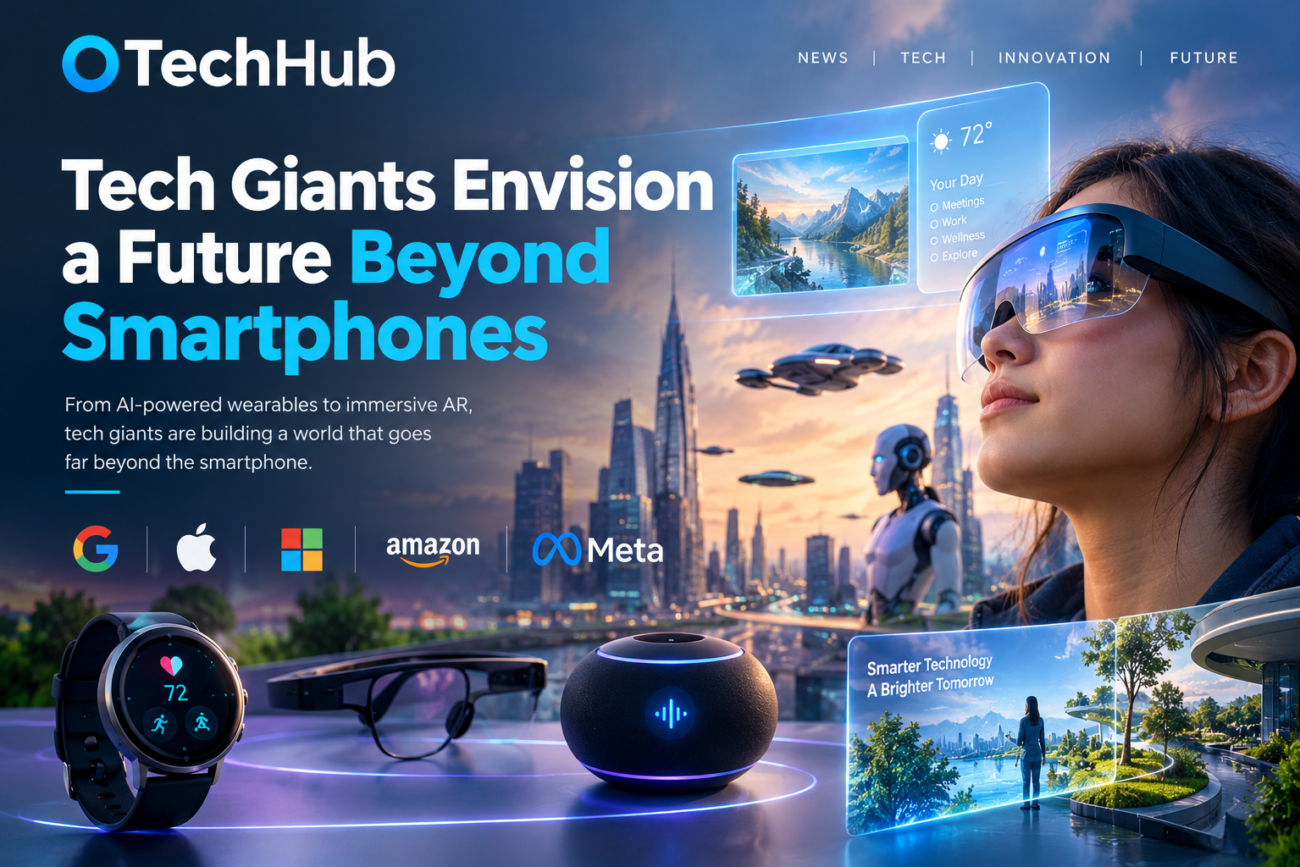
The smartphone has transformed communication, entertainment, shopping, and work. Now, major technology companies are exploring a different way to interact with digital services: AI-powered smart glasses, intelligent wearables, spatial computing, and assistants that can respond without requiring users to constantly look at a screen.
For more than a decade, smartphones have remained at the center of everyday computing. People use them to navigate unfamiliar streets, manage finances, capture photographs, communicate with colleagues, and access almost any online service. Yet technology companies are beginning to explore whether these activities could become more natural, hands-free, and connected to the physical world.
Companies including Meta, Google, Apple, and Samsung are investing in technologies that could expand computing beyond traditional mobile screens. Artificial intelligence is an important part of this transition because it allows devices to interpret spoken requests, analyze visual information, and provide assistance based on context.
However, this does not mean smartphones are about to disappear. Instead, the industry may be moving toward an ecosystem in which phones work alongside smaller, more specialized devices.
This article examines why tech giants envision a future beyond smartphones, which technologies could lead the transition, what the major companies are developing, and the challenges that will determine whether these ideas become mainstream.
Why Are Tech Giants Looking Beyond Smartphones?
The smartphone remains one of the most versatile consumer technologies ever developed. Nevertheless, companies are searching for new ways to deliver digital services without requiring users to perform every task through a touchscreen.
Traditional mobile interaction usually follows a familiar pattern: take out a phone, unlock it, open an application, find the appropriate feature, and complete an action. This method works well for complicated tasks, but it can be inconvenient when someone is walking, driving, cooking, working with their hands, or trying to remain focused on their surroundings.
Several developments are encouraging technology companies to investigate alternative interfaces.
Artificial Intelligence Is Changing How People Use Devices
AI assistants can interpret natural-language requests, summarize information, answer questions, and help users complete certain tasks. As these systems become integrated into more devices, people may not always need to navigate multiple applications manually.
For example, someone visiting another country could ask an assistant to translate a conversation, explain a sign, or provide directions. With suitable hardware and software, some of these activities could happen through wearable devices rather than a phone screen.
The important change is not simply adding AI to another gadget. It is making computing more responsive to a person’s immediate needs.
Consumers Want More Convenient Experiences
Wearable technology can provide information while leaving users’ hands free. Smartwatches already offer notifications, fitness tracking, and quick communication. Wireless earbuds enable voice interactions, while smart glasses can combine cameras, microphones, speakers, and, in some models, visual displays.
Each device serves a different purpose. A watch may be convenient for checking a notification, whereas glasses could help someone identify a landmark or follow directions without repeatedly looking down.
These products will succeed only if they make everyday tasks genuinely easier than existing alternatives.
Companies Want to Shape the Next Computing Platform
Technology companies have strong incentives to develop the next generation of personal computing. New platforms can create opportunities for hardware sales, software subscriptions, digital services, developer ecosystems, and AI-powered experiences.
The company that creates a widely adopted interface may influence how users discover information, interact with applications, and access online services.
Consequently, the competition extends beyond manufacturing a fashionable device. It also involves operating systems, AI assistants, cloud infrastructure, application compatibility, privacy protections, and developer support.
Smart Glasses Could Become a Major Part of the Next Technology Shift
Smart glasses are among the clearest examples of how companies are experimenting with computing beyond smartphones.
Unlike conventional glasses, these devices may incorporate cameras, microphones, speakers, wireless connectivity, and AI capabilities. Some models focus on audio and photography, while others are being developed with displays that can present information within the user’s field of view.
The combination creates opportunities for hands-free assistance without requiring a large screen.
How AI-Powered Glasses Could Be Used
Consider a person walking through a city for the first time. Instead of repeatedly checking a map, the user might receive spoken directions from a compatible pair of glasses.
A traveler could ask an AI assistant to translate a sign or help understand a menu. A student might use a compatible device to ask questions about an object in a museum. Someone working in a warehouse could potentially receive task instructions without interrupting a hands-on activity.
These are examples of possible uses, not guarantees that every product can perform every task. Available functions depend on the device, software, language support, connectivity, and regional availability.
Google demonstrated its vision for Android XR glasses in May 2025, including Gemini-powered assistance, messaging, navigation, photography, and live language translation. Its official Android XR announcement describes the company’s approach to bringing AI into glasses and headsets.
Meta’s Approach to AI Glasses
Meta has been developing smart glasses through its partnership with eyewear manufacturer EssilorLuxottica, including products sold under the Ray-Ban brand.
The appeal of this approach is that the hardware resembles familiar eyewear rather than a bulky computer headset. Depending on the model and region, compatible glasses can support photography, video recording, audio, calls, and interactions with Meta AI.
In September 2026, Meta announced additional AI-glasses products and features, including Ray-Ban Meta Audio glasses and further developments involving its AI assistant. Details are available in the company’s official announcement.
Meta’s strategy illustrates one possible path toward more accessible wearable computing: integrate useful technology into a product people might already want to wear.
However, adoption will depend on more than design. Battery life, comfort, camera quality, privacy expectations, price, and the usefulness of the AI assistant will all influence whether consumers continue using these products after the initial novelty fades.
Neuralink and Other BCI Developers
Brain-computer interfaces (BCIs) represent another possible direction for the future of human-computer interaction. Unlike traditional devices that rely on touchscreens, keyboards, or voice commands, BCIs use signals associated with brain activity to help users communicate with external systems.
Neuralink is one company developing implantable brain-computer interface technology. Other research groups and companies are exploring different approaches, including non-invasive systems that measure brain activity using sensors placed outside the body.
One important potential application is helping people with severe paralysis interact with computers. Depending on the system, users may be able to control a cursor or perform selected digital tasks through decoded neural signals.
Despite this progress, brain-computer interfaces remain a developing field. Different systems have different capabilities, and some require medical procedures, specialized equipment, and professional support. They are not yet a practical replacement for smartphones for most people.
What Is Spatial Computing?
Spatial computing is a way of interacting with digital information in relation to the physical environment. It combines technologies such as sensors, cameras, computer vision, augmented reality (AR), and virtual reality (VR) to help devices understand and respond to their surroundings.
For example, a person wearing compatible smart glasses might see navigation directions overlaid on the real world. A student could explore a three-dimensional model of the solar system, while an engineer might examine a digital representation of a machine before repairing it.
Spatial computing can also support training, education, design, entertainment, and collaboration. Instead of interacting only with information displayed on a flat screen, users can engage with digital objects in a more immersive environment.
Nevertheless, adoption will depend on making these devices comfortable, affordable, safe to use, and useful enough for everyday activities. Spatial computing is not necessarily a replacement for smartphones; it may become another way to access digital services.
Smartphones vs. Emerging Devices: What Is the Difference?
Smartphones remain versatile devices because they combine communication, internet access, photography, navigation, entertainment, and thousands of applications in a portable package. Their familiar touchscreens make them useful for a wide range of everyday tasks.
Emerging devices approach computing differently. Smart glasses can display information within a user’s field of view, smartwatches provide quick access to notifications and selected functions, and extended-reality headsets create immersive digital environments.
AI-powered wearables may also offer more context-aware assistance through voice commands, sensors, and on-device processing. Brain-computer interfaces could eventually provide alternative input methods for certain users and applications.
The main differences involve how users interact with technology, where information appears, and how devices understand their environment.
| Feature | Smartphones | Emerging Devices |
|---|---|---|
| Main interaction | Touchscreen and voice | Voice, gestures, sensors, or immersive displays |
| Display | Handheld screen | May use glasses, headsets, or small displays |
| Portability | Generally easy to carry | Varies by device |
| Main advantages | Versatility and established apps | New forms of interaction and hands-free access |
| Current limitations | Requires screen interaction for many tasks | Cost, battery life, comfort, privacy, and limited applications |
Rather than disappearing overnight, smartphones may continue working alongside these newer technologies. The future could involve a connected ecosystem in which users choose the most suitable device for each task.
Can People Control Devices Directly With Their Thoughts?
Yes, certain brain-computer interface systems already allow people to control specific computer functions using decoded brain signals. Research has demonstrated applications such as moving a cursor or interacting with digital interfaces, including in people who have lost some ability to move or communicate.
However, this technology does not mean that computers can freely read every thought in a person’s mind. A BCI is designed to interpret particular signals and translate them into commands for a defined purpose. Its capabilities depend on the technology, the individual, and the task being performed.
Some systems use implanted electrodes, while others use external sensors to measure brain activity. These approaches differ in signal quality, complexity, potential risks, and the tasks they can support.
In the future, BCIs could create additional ways for people to interact with computers, especially in healthcare and assistive technology. Widespread everyday use, however, faces challenges involving safety, reliability, cost, privacy, and the interpretation of neural signals.
For now, thought-based control is a specialized technology rather than a general replacement for smartphones, keyboards, or voice assistants.
The Future of Computing: More Choices, Not Just Smartphones
The evolution of computing is not limited to creating a device that replaces the smartphone. It involves developing new ways for people to access information and interact with digital services.
AI wearables, spatial computing, smart glasses, and brain-computer interfaces each offer different possibilities. Some technologies are already available, while others remain experimental or face significant technical challenges.
Ultimately, the next generation of computing devices will need to solve real problems, protect user privacy, and offer clear advantages over existing technology. Smartphones may remain central to everyday life even as new devices expand how people communicate, work, learn, and experience the digital world.
For OTechHub readers, the most important question is not simply which company will build the next big device, but which technologies will provide meaningful benefits in everyday life.
Google, Samsung, and the Development of Android XR
Google is pursuing another important part of the transition through Android XR, a platform designed for extended-reality devices, including headsets and glasses.
Extended reality, commonly abbreviated as XR, includes virtual reality, augmented reality, and mixed-reality experiences. These technologies combine digital environments or information with the user’s surroundings in different ways.
Google introduced Android XR in partnership with Samsung and Qualcomm in December 2024. The platform is designed to support an ecosystem of devices rather than a single product.
What Could Android XR Make Possible?
XR devices can place digital information into a user’s environment or provide a large virtual workspace. Depending on the hardware, applications could support immersive entertainment, remote collaboration, training, navigation, and productivity.
For example, a designer might examine a three-dimensional model in an immersive environment. A remote worker could arrange several virtual windows around their workspace. A technician might consult digital instructions while inspecting equipment.
Google’s platform also incorporates Gemini, its AI assistant, into its broader XR vision. This could allow users to interact with applications through conversational requests and contextual information.
Google’s Android XR platform page provides further information about the ecosystem and compatible devices.
The broader opportunity is that Android XR could give developers a common foundation for creating experiences across different manufacturers’ hardware. A larger ecosystem could encourage more applications, although widespread adoption is not guaranteed.
Why Samsung Matters
Samsung contributes experience in consumer electronics, mobile hardware, displays, and device manufacturing. Its collaboration with Google creates an opportunity to combine hardware development with an established software ecosystem.
Samsung’s Galaxy XR headset, announced as part of this ecosystem, demonstrates that the strategy extends beyond ordinary glasses. Headsets can provide more immersive experiences and larger virtual workspaces, although their size and cost may make them less suitable for constant everyday use.
Lightweight glasses and immersive headsets address different needs. Glasses may be more practical for quick assistance while moving around, whereas headsets can provide richer experiences for focused work or entertainment.
Apple’s Vision: Spatial Computing and a Connected Ecosystem
Apple has approached the future of computing through its broader ecosystem of devices and its spatial-computing work.
The Apple Vision Pro introduced a way to interact with digital applications in an immersive environment while remaining aware of the physical surroundings. Rather than relying exclusively on a conventional display, spatial computing places application windows and digital content within a three-dimensional space.
Apple describes this approach on its official Vision Pro website.
How Spatial Computing Differs From Smartphones
A smartphone presents most applications on a relatively small, flat display. Spatial computing can position multiple windows within a user’s environment, making digital workspaces feel larger and more flexible.
Potential applications include immersive media, three-dimensional design, training, visualization, and collaboration. Professionals who work with complex visual information may find these capabilities particularly useful.
Nevertheless, a headset is not a direct substitute for a phone. It is generally larger, requires more power, and serves different situations. The long-term direction of Apple’s product strategy should not be confused with a confirmed plan to eliminate the iPhone.
Apple’s wider ecosystem also shows why a transition beyond smartphones may happen gradually. Existing devices can continue to provide connectivity, applications, processing, and familiar services while newer products introduce additional ways to interact with them.
AI Assistants Could Become the Common Interface
Smart glasses, watches, earbuds, and headsets have different designs, but AI assistants could connect many of their capabilities.
Instead of learning a separate interface for every device, users may increasingly issue requests through natural language. An assistant could interpret a question, retrieve information, and help initiate an action using supported applications and services.
For example, a person might ask for a meeting summary through earbuds, review a notification on a watch, and open a detailed document on a laptop. The devices could provide different interfaces to connected services rather than functioning as completely independent systems.
This approach is sometimes associated with ambient computing: technology that is available when needed without demanding continuous attention.
Why Context Matters
A useful assistant needs to understand more than individual words. Depending on the task, it may need information about the user’s location, schedule, current activity, preferred language, or the object being discussed.
Cameras and microphones can provide additional context, but they also create significant privacy responsibilities. Users should be able to understand what information a device collects, when it is processed, and how it is stored or shared.
AI systems can also misunderstand requests or produce incorrect answers. High-stakes decisions should not rely on an assistant simply because it is convenient to access.
The future of AI-powered devices will therefore depend on reliability, user control, transparent data practices, and the ability to complete tasks consistently.
Will Smartphones Disappear?
Despite growing interest in alternative devices, smartphones are likely to remain important for the foreseeable future.
They already combine cameras, displays, processors, storage, connectivity, authentication, and access to extensive application libraries. Billions of users are familiar with their interfaces, and developers have spent years building services for mobile platforms.
Replacing that ecosystem would be difficult.
Smartphones Still Handle Complex Tasks Well
A touchscreen remains practical for activities requiring detailed input, such as editing documents, managing finances, comparing products, entering passwords, and reviewing large amounts of information.
Voice commands are convenient for some tasks but less suitable for others. Public environments may be noisy, spoken instructions can be ambiguous, and sensitive information is not always appropriate to discuss aloud.
Visual displays also provide a useful way to confirm details before completing an action. For this reason, wearable devices may complement smartphones instead of replacing them completely.
Cost and Accessibility Will Influence Adoption
New hardware must offer enough value to justify its price. Consumers may be reluctant to buy additional devices if their smartphones already perform the required tasks.
Comfort, battery life, repairability, prescription-lens support, accessibility features, and availability in local markets will also matter.
A technology that works well for early adopters may need significant improvements before it becomes practical for a broad audience.
The likely outcome is a gradual expansion of the computing ecosystem, with smartphones continuing to handle many tasks while wearables and immersive devices take on specialized roles.
Privacy and Security Could Determine the Future
Devices that can observe a user’s surroundings introduce privacy questions that are different from those associated with traditional phones.
Smart glasses may capture images or audio in public places. AI assistants may process personal conversations or contextual information. Connected wearables may collect location, activity, and other sensitive data.
These capabilities can be useful, but they require responsible design and clear safeguards.
Important considerations include:
- Consent and awareness: People nearby should not be unknowingly recorded where privacy expectations or laws prohibit it.
- Data collection: Manufacturers should explain what information is processed and why.
- Storage and retention: Users should be able to understand how long recordings or other personal information are retained.
- Account security: Connected devices need secure authentication, software updates, and protection against unauthorized access.
- User control: Clear indicators, recording controls, and privacy settings can help people make informed choices.
Security also matters when devices connect to cloud services or other personal electronics. A compromised account or poorly secured application could expose more than one device.
Technology companies that make privacy and security understandable may earn greater trust. Conversely, products that feel intrusive could face resistance even when their technical capabilities are impressive.
What This Shift Could Mean for Businesses and Developers
The move toward wearable computing and AI-enabled interfaces could create new opportunities for businesses, software developers, and digital publishers.
Companies may develop applications that respond to spoken questions, provide hands-free instructions, or display relevant information in an immersive environment. Retailers could explore assisted product discovery, while manufacturers could investigate visual guidance for maintenance and training.
Developers will need to consider the strengths and limitations of each interface. A task designed for a touchscreen may not translate naturally to voice or wearable displays.
For digital publishers, discoverability could also evolve as users ask AI assistants direct questions rather than browsing lists of websites. Clear writing, factual accuracy, useful structure, and accessible technical information will remain important, although no publisher can guarantee visibility in AI-generated answers.
Businesses should approach these possibilities as emerging opportunities rather than assume that existing websites, applications, or marketing channels will immediately become obsolete.
For more practical explanations of emerging technologies, readers can explore the Technology section on OTechHub and the AI category, which are intended to cover developments in digital tools and artificial intelligence.
What Comes Next for Personal Computing?
The next stage of personal computing may be defined less by a single replacement for the smartphone and more by a collection of connected devices.
Smart glasses could offer hands-free assistance. Earbuds may provide convenient voice interactions. Watches can deliver short notifications and health-related features. XR headsets can support immersive applications, while smartphones continue to manage detailed tasks and connect services.
AI could make these devices feel more consistent by helping users access information and complete actions across different contexts. But the experience will depend on battery efficiency, connectivity, processing power, application support, and the quality of the underlying software.
The most successful products are unlikely to be those with the longest feature lists alone. They will need to solve everyday problems reliably, fit naturally into people’s routines, and offer clear benefits over existing alternatives.
For now, the smartphone remains a powerful and practical device. The important development is that major technology companies are exploring what personal computing could look like when a touchscreen is no longer the only way to interact with digital services.
Frequently Asked Questions
What does a future beyond smartphones mean?
It refers to a possible shift toward multiple forms of personal computing, including smart glasses, AI assistants, wearables, and spatial-computing devices. Smartphones may continue to play a central role even as other interfaces become more capable.
Which companies are developing alternatives to traditional smartphone interaction?
Meta is developing AI-powered glasses, Google and Samsung are working on Android XR devices, and Apple has introduced spatial computing through Vision Pro. These companies have different strategies, and their products serve different use cases.
Can AI smart glasses replace a smartphone?
Current smart glasses are better understood as companion devices for selected tasks. They can offer hands-free features, but smartphones remain more versatile for complex input, detailed browsing, and many applications.
What is spatial computing?
Spatial computing allows people to interact with digital content positioned within a three-dimensional environment. Depending on the device, it can support immersive entertainment, virtual workspaces, design, visualization, and training.
What are the biggest obstacles to a future beyond smartphones?
Major challenges include battery life, affordability, comfort, privacy, security, application availability, and whether new devices provide enough practical value to change established habits.
Conclusion
Tech giants envision a future beyond smartphones because advances in artificial intelligence, wearable hardware, and spatial computing are creating new ways to interact with technology. Smart glasses, connected assistants, and immersive headsets could make certain digital tasks more convenient and better integrated into daily life.
However, replacing smartphones entirely would require more than impressive demonstrations. New devices must deliver dependable performance, protect personal information, remain comfortable, and offer benefits that justify their cost.
The most plausible near-term future is one in which smartphones coexist with other connected devices. As AI and wearable technology develop, people may spend less time reaching for a screen for simple tasks while continuing to rely on phones for activities that benefit from a full display.
For more technology insights and practical guides, visit the OTechHub and read our introduction, Welcome to OTechHub: Your Guide to Technology and Innovation, to learn more about the subjects covered by the publications.

One thought on “Tech Giants Envision a Future Beyond Smartphones: What Comes Next?”