
People who search for test.com pricing enterprise plans usually want one number. The real answer is a published starting price, a few fixed fees on top of it, and a volume-based quote that only the vendor can finalize.
Test.com, Inc. is the company behind Gauge Online, an examination and certification management platform. Its terms of service describe Gauge as a division of Test.com, Inc., and its pricing pages carry a Test.com, Inc. copyright notice. So “Test.com Enterprise” and “Gauge Enterprise” refer to the same product.
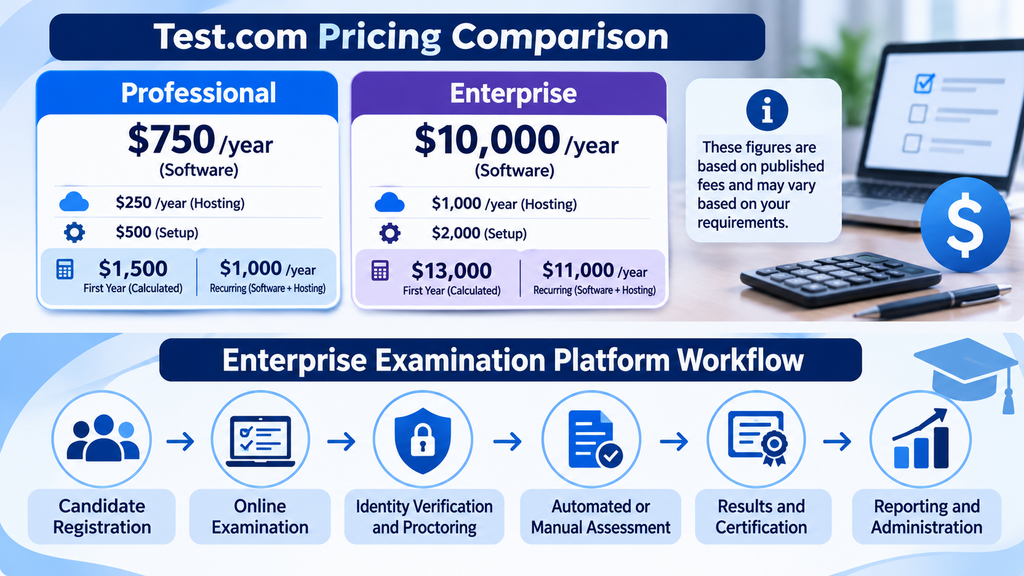
According to the official Gauge pricing page, the Enterprise plan starts at $10,000 per year, plus $1,000 hosting and a $2,000 one-time setup fee. That puts the first-year starting cost at $13,000 by simple arithmetic. It is not a quotation, and the final cost depends on exam volume, proctoring and contract terms.
Pricing and features in this guide were checked against Gauge’s official pages on November 11, 2026. Vendors change prices, so confirm current figures before budgeting.
What Is Test.com and How Does Gauge Online Work?
Gauge is an online test delivery and certification management platform. It is not a software QA tool, so it has nothing in common with TestRail, Testmo or similar products. It is also a different kind of product from TestGorilla, which is built for employment screening.
Gauge is aimed at organizations that run formal examination programs, such as:
- Professional certification bodies and trade associations
- Training providers and educational institutions
- Government agencies
- Corporate training and compliance departments
A basic quiz app lets someone write questions and share a link. A structured examination platform handles the harder parts:
- Secure exam delivery
- Candidate records
- Proctoring
- Item-level reporting that a psychometrician can review
- Audit trails
- Credentials that can be verified and renewed
Gauge’s pricing page makes this distinction itself when it compares Gauge with an LMS. It says an LMS manages learning content, while Gauge adds secure exam delivery, integrated proctoring, verifiable certificates, item-level reporting and full audit trails. That is vendor positioning, but it describes the category buyers should be comparing.
Test.com Pricing Plans at a Glance
Gauge publishes two plans, and pricing depends on annual exam volume. Figures marked “calculated” are our arithmetic from the published charges, not vendor quotes.
| Professional | Enterprise | |
|---|---|---|
| Software, starting at | $750/year | $10,000/year |
| Hosting | $250/year | $1,000/year |
| One-time setup | $500 | $2,000 |
| First year (calculated) | $1,500 | $13,000 |
| Later years (calculated) | $1,000/year | $11,000/year |
| Intended volume | Programs getting started or growing; eight usage-based levels | Organizations needing more than 10,000 tests per year |
The calculated recurring figures assume the published annual fees stay the same and the setup fee is not charged again.
Don’t confuse the calculator example with the plan price. The pricing page also has an estimator. Its default display shows $1,000 per year for up to 500 exams, or $2.00 per exam. That is a sample result for one volume tier, not a universal Professional price, and it is not the same as the $750 starting figure.
How Much Does Test.com Enterprise Cost?
Gauge’s published Enterprise starting charges are:
| Component | Amount | Frequency |
|---|---|---|
| Software (starting) | $10,000 | Annual |
| Hosting | $1,000 | Annual |
| Setup | $2,000 | One time |
| First-year starting cost | $13,000 | Calculated |
| Recurring starting cost | $11,000 | Calculated |
The first year costs more because setup is a one-time charge. From the second year, on the published figures, the recurring cost is software plus hosting.
Treat these as floors. Gauge calls them “starting” prices, and its volume pricing, proctoring and any optional services are quoted separately.
How Does Test.com Per-Test Pricing Work?
For Enterprise, Gauge says volume pricing starts at $3 per test with all features included. It says the rate falls as volume grows, and that its highest-volume customers pay well under $1 per test. Exact rates come from a conversation with the vendor.
What the public pages do not explain. They do not say how the $10,000 annual starting price and the per-test rate fit together in a contract. The fee might be a minimum commitment, a platform fee on top of usage, or an entry point for a volume tier. The published material doesn’t settle it, so this guide doesn’t guess.
In particular, do not add $3 to the $10,000 figure and do not assume every customer pays both in the same way.
A hypothetical example. Take an organization with 10,000 first-time candidates and 2,000 retakes in a year. This is not a Gauge quote or a real customer:
- If retakes count as billable tests, the volume is 12,000 tests.
- If they don’t, the volume is 10,000.
- At the $3 starting rate alone, that is a $6,000 difference ($36,000 vs. $30,000), before any annual fee, hosting, setup or proctoring.
Since the real rate is likely lower and the contract structure is unknown, the example only shows how much a single definition can move the total. Ask for an itemized written quotation that answers five things:
- Whether the annual software fee and per-test charges are separate.
- What exam volume is included in the quoted price.
- Whether retakes count as additional tests.
- How volume above the quoted amount is billed.
- Whether the rate changes at renewal.
What Is Included in Test.com Enterprise?
Gauge’s Enterprise page and pricing page list the following. These are vendor descriptions. Only a trial or demo will show how well each works for your program.
| Area | What Gauge says it offers | What it means in practice |
|---|---|---|
| Exam delivery and reporting | Online exams, item-level reports and exports | Your psychometric team can review how questions perform |
| Certification and badging | Certificates, credentials, renewals | Pass results can lead to a verifiable credential |
| Proctoring integration | Virtual proctoring from four vendors, on one invoice | Remote supervision without separate vendor billing |
| Lessons | Training content within the platform | Teaching and testing can sit together |
| eCommerce | Payment capability | Exam or program fees can be collected in the platform |
| API and webhooks | REST API, real-time webhooks | Registration and results can sync with your CRM, LMS or public directory |
| Single sign-on | Login through your own authentication | Candidates don’t need a separate account |
| Branding | Custom CSS and JavaScript | The test experience can match your site |
Gauge also states support for 26 languages and for multiple certification programs in one environment.
The brief for this guide asked about on-site proctoring. Gauge’s Enterprise page describes virtual proctoring, and we did not find on-site proctoring confirmed on the pages we reviewed. Ask directly if you need it.
Professional vs. Enterprise: Which Plan Is Better?
Enterprise is not the right choice for every organization.
| Factor | Professional | Enterprise |
|---|---|---|
| Starting cost | $750/year plus fees | $10,000/year plus fees |
| Intended size | Starting or growing programs | High-volume certification programs |
| Volume | Usage-based tiers (e.g., up to 500 exams in the calculator example) | More than 10,000 tests per year |
| Capabilities | Testing, user management, security, reporting, customization | Adds certification and badging, proctoring integration, lessons, eCommerce, developer tools |
| Implementation | Lighter | Phased: discovery, configuration, migration, integrations, validation, launch |
| Buying focus | Volume tier, needed modules | Contract structure, integrations, security review |
Professional may be enough if your volume is modest, you don’t need credential management or custom integrations, and you can run setup yourself.
Enterprise deserves a look if you run more than 10,000 tests a year, need your exam system to feed a member portal or CRM, or have security review requirements.
One caution on the Professional plan: the pricing page says you “only pay for the features you need.” Because modules are added individually, the final Professional cost can rise above the starting price depending on what you select.
Additional Costs and Things Buyers Should Check
Verified published charges
- Hosting: $250/year (Professional) or $1,000/year (Enterprise).
- Setup: $500 or $2,000, one time.
- Proctoring: priced per session and included in your quotation.
Needs vendor confirmation
- Exam volume and overages. Which tier you land in and what happens if you exceed it.
- Retakes. Whether they count as new tests.
- Integrations. Gauge says its technical team works directly with your developers on SSO and API work. Ask whether that is included, and budget for your own developer time either way.
- Migration. Gauge says items, candidate records and credential history can be imported, and it offers managed implementation if you prefer to hand off setup. Ask whether managed implementation is a separate charge.
- Renewals. Whether rates change after year one.
- Contract terms. Gauge states there’s no long-term commitment and that you can cancel anytime. Gauge’s terms of service also say a signed Service Provider Agreement controls over the website terms, so what binds you is the agreement you sign.
- Proctoring volume. Per-session fees can grow quickly if every attempt is proctored.
Security, Integrations and Enterprise Requirements
Gauge describes these controls on its Enterprise page:
- Custom authentication, including multi-factor and SSO
- IP range and referral-based restrictions by user group
- Granular permissions by user group
- Exportable audit trails covering test sessions, user actions and administrative changes
- Encrypted certificate delivery and tamper-proof credential records
- Hosting, backup, recovery and incident-response documentation, available for security review
These are vendor-described features. They are not independent certifications. We did not find a verified SOC 2, ISO 27001 or similar certification on Gauge’s official pages, so this guide makes no such claim. If your organization needs one, ask Gauge for the current documentation in writing.
A sound evaluation covers five things:
- How candidate data is stored and who owns it
- Who inside your organization gets which permissions
- Whether audit logs meet your accreditor’s expectations
- What the vendor’s own documentation actually says
- What your own regulatory obligations require
Teams without a security background may find understanding cybersecurity risks a useful primer before reading vendor security documents.
Exam platforms also belong in your wider oversight. Someone in your organization should own decisions about vendor access, data retention and integrations. For many teams that is a question of technology governance and accountability as much as of software features.
Does Test.com Offer a Free Trial?
Yes. Gauge states a 30-day free trial with no credit card required. It says a 30-minute call confirms your price and sets up your trial site within two business days.
To get real value from it:
- Load a realistic sample of your own questions.
- Run a mock exam with colleagues as candidates.
- Test an integration or SSO flow with your developers.
- Check what reports and exports you’d get.
- Look at what a certificate and credential record look like.
Per Gauge’s terms, a trial client’s use of the website can be ended at will by either side. That is normal for a trial, but do not store anything you can’t recreate.
How to Evaluate Test.com Reviews and Independent Feedback
A user review is written by someone who has used the product, based on their own experience. That differs from vendor marketing, which is written to sell. Wikipedia’s overview of software reviews also notes that online review systems can be manipulated, so source and context matter.
Do the following instead of relying on ratings:
The Gauge software listing on Capterra currently shows zero user reviews and no public starting price. That means there’s no independent rating to lean on, and nothing here is a verdict on the product. It only means you’ll need other evidence.
- Ask for customer references from organizations of your size and type, and speak to them directly.
- Test against your own requirements during the trial.
- Compare written quotes from more than one vendor.
- Treat testimonials on a vendor’s own site as marketing, not independent feedback.
Questions to Ask Before Requesting an Enterprise Quote
Prepare your numbers first. Estimate annual candidates, expected retakes, how many attempts need proctoring, and your growth over the contract term. Then use this checklist:
- Volume: How many tests per year are included in the quote?
- Per-test charges: What is the rate, and how is it billed above the included volume?
- Annual fee: Is it separate from per-test charges?
- Retakes: Are they billable tests?
- Hosting: What exactly does the fee cover?
- Proctoring: What is the per-session price by vendor?
- Integrations: What help does Gauge provide for API, webhooks and SSO?
- Migration: Is import included, or is managed implementation extra?
- Support: What service levels apply?
- Renewal: Do rates change after the first term?
- Cancellation: What do the contract terms say?
- Data export: Can you export all items, candidates and credential history, and in what format?
Frequently Asked Questions
1. How much does Test.com Enterprise cost?
Gauge publishes a starting price of $10,000 per year plus $1,000 hosting and a $2,000 one-time setup fee. Total cost depends on volume and other quoted items.
2. Is Test.com the same as Gauge Online?
Gauge’s terms describe it as a division of Test.com, Inc., so they refer to the same company and product.
3. What does the Professional plan cost?
It starts at $750 per year, plus $250 hosting and a $500 one-time setup fee. That is $1,500 in the first year and $1,000 per year after, by our calculation.
4. Is the $13,000 Enterprise price the final cost?
No. It is our arithmetic on the published starting charges, not a vendor quote. Volume pricing and proctoring are quoted separately.
5. How much does Test.com charge per test?
Enterprise volume pricing starts at $3 per test and decreases with volume. Gauge says its highest-volume customers pay well under $1 per test.
6. Does Test.com offer a free trial?
Yes: 30 days, no credit card required.
7. Is proctoring included in Enterprise?
Enterprise includes proctoring integration, but proctoring itself is priced per session and included in your quotation, so it isn’t free.
8. Does Gauge support API and SSO integrations?
Gauge states that it offers a REST API, webhooks and single sign-on.
9. Is Test.com suitable for small businesses?
The Professional plan is aimed at programs that are starting or growing. Whether it fits depends on whether you need formal examination and credential features.
10. How can an organization obtain an exact Enterprise quotation?
Book the call Gauge links from its pricing page and bring your exam volume, retake estimate and required modules. Ask for the quote in writing, itemized.
Final Verdict
Gauge targets organizations that run structured examination and certification programs, especially high-volume ones. Its published pricing is more transparent than many enterprise software vendors: starting prices, hosting and setup are listed openly.
The public pages stop short of explaining how the annual fee and per-test rates combine, and that gap is where budgets go wrong. Whether Gauge is good value for your program depends on your volume, your retake policy, your proctoring needs and the contract you sign.
We can’t say it is the best or cheapest option, and the public evidence doesn’t allow either claim. Run the trial, ask for references, and get everything in writing.
