Introduction
A research dossier for target company analysis is a structured document that gathers evidence about one specific business so you can make a decision with fewer blind spots. The “target company” is simply the organization under investigation: a prospective client, supplier, competitor, employer, partner or acquisition candidate. It does not refer to Target Corporation, the American retailer.
People build dossiers because scattered tabs and half-remembered facts are hard to trust and harder to reuse. A good company research dossier, sometimes called a business research dossier, records what is known, how it is known and what remains uncertain. This guide explains the concept, walks through a ten-step company research process, shows where AI helps and where it fails, and ends with a template you can copy.
What Is a Research Dossier for a Target Company?
A research dossier is an organized, evidence-based file about a single company, built around a defined purpose. That purpose decides what you collect. A sales team qualifying a prospect needs to know what the company sells, who buys it, what has changed recently and who makes decisions. An investor assessing a public company needs filings, debt, ownership and disclosed risks. A procurement manager vetting a supplier cares about delivery capacity, financial resilience and operational continuity. A job seeker wants leadership stability, reputation and hiring signals.
The same company can therefore require three different dossiers. Start with the decision, not the data, and the document stays short enough to use.
What Is Research Dossier For Target Company?
ResearchDossierForTargetCompany.com is a specific website, and it is not the same thing as the general concept above. Its About page describes it as an independent educational platform offering guides, templates, checklists and analysis frameworks for company research, written for beginner and intermediate researchers such as investors, sales teams, consultants, job seekers, students and journalists.
When this article was reviewed on 11 November 2026, the site offered:
- A ten-step research workflow and an eleven-part framework covering identity, business model, finances, competitors, reputation, risks and verification.
- A source-verification worksheet, shown as an on-page table with fields for the claim, source, publisher, URL, publication date, access date, source type and verification status.
- A dossier template page meant to be copied into Word, Google Docs or Notion, plus a listed set of further resources (checklist, report, SWOT, competitor and due diligence templates) that were not individually reviewed.
- A company-comparison worksheet described on the homepage; no downloadable file was seen.
The homepage also shows a “Live Website Research Tool”, which says it reads public page information from a URL you enter, and a “Research Assistant” chat widget. This review did not test either, and the site does not explain what the assistant does. For that reason, this article does not describe the site as an AI agent, a financial database or due diligence software. Its About page does not name individuals or a registered business, and it states that the content is not financial or legal advice. Treat it as one educational starting point, and verify claims at the original source.
Research Dossier vs Company Profile vs Due Diligence
These terms overlap, but they do different jobs.
| Concept | Main purpose |
|---|---|
| Company profile | A basic overview of a business: who it is, where it operates, what it sells |
| Research dossier | Organized, evidence-based research for a specific decision, with sources and gaps recorded |
| Due diligence | Deeper verification before a transaction or major commitment, often with professional input |
| Competitive analysis | Understanding a company’s position relative to its competitors |
A dossier can feed the other three, but it does not replace them. Public-source research cannot confirm contracts, tax position, litigation exposure or software security. Those questions need legal, financial or technical professionals.
What Should a Target Company Research Dossier Include?
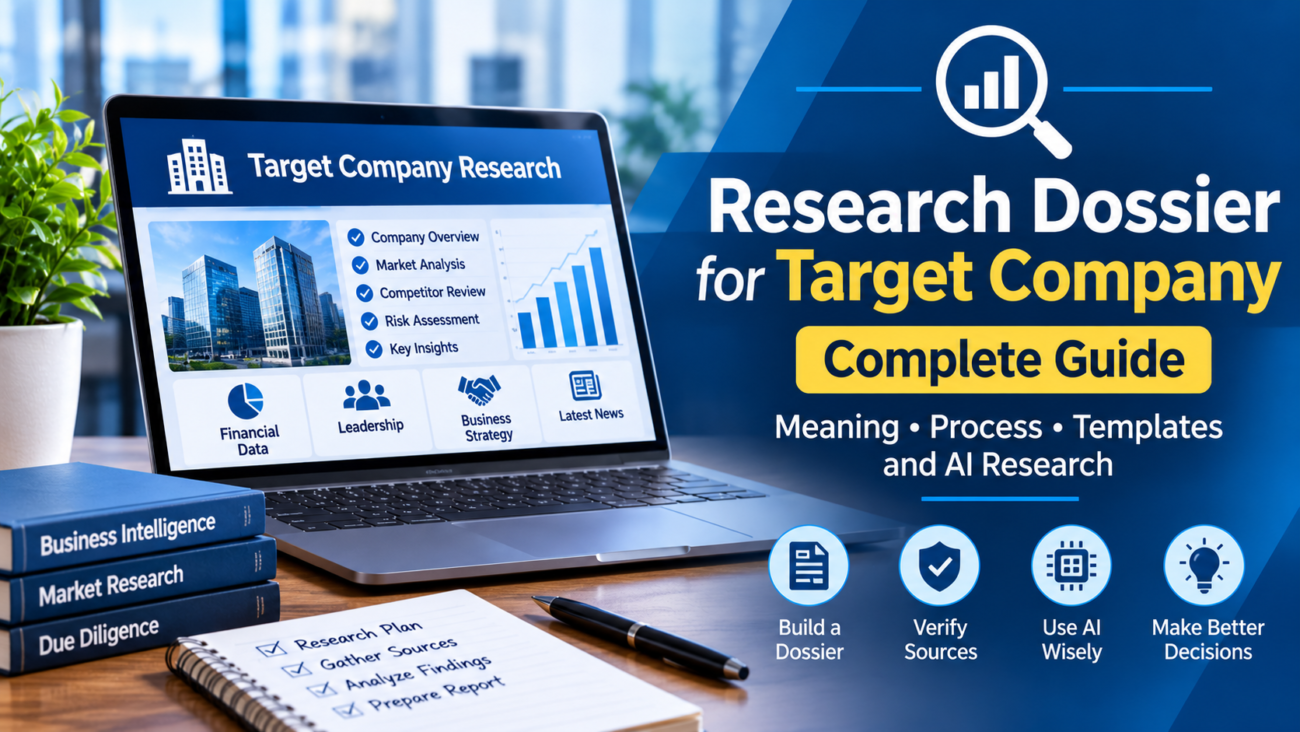
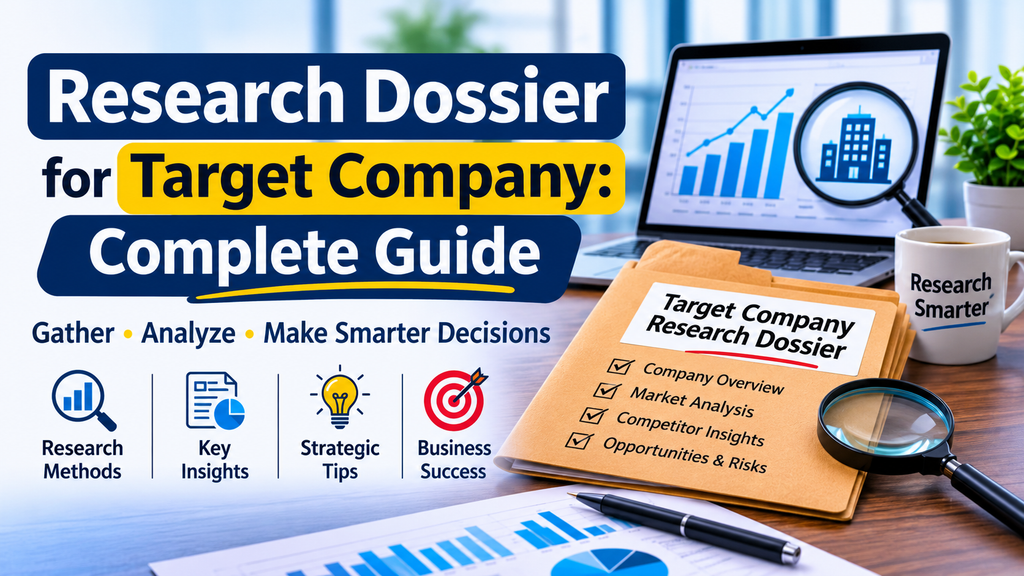
Depending on your objective, a company research report can draw on sixteen areas:
- Identity: company overview, legal name, website and headquarters, so every later fact attaches to the right entity.
- People: ownership and leadership, including any parent company.
- Commercial picture: products and services, business model and revenue sources, customers and target markets.
- Financial information: reported figures with period, currency and source, where available.
- Market position and competitors: a few relevant rivals, compared on the same criteria.
- Recent news and developments: dated, attributed events.
- Technology, infrastructure, cybersecurity and operational risks: what the public record shows about how the business runs and how resilient it is.
- Legal and regulatory information: filings, disputes and their status, licences.
- Reputation and customer feedback: patterns, not single reviews.
- Opportunities and potential concerns: your analysis, labelled as analysis.
- Evidence, source links and information gaps: the proof, and what is missing.
- Executive summary and recommended next steps: written last.
Not every company will have all of this publicly available. Listed companies publish detailed filings; many private companies publish very little. For private companies, label each item as verified (from an official record), a company statement, a third-party estimate or report, or unavailable. “Unavailable” is a finding, not a failure, and missing data does not prove a company is healthy or struggling.
How to Create a Research Dossier Step by Step
- Define the research objective. Write one sentence on the decision the dossier supports and who will read it.
- Confirm the company’s identity. Match the legal entity, trading name, official website, location and any parent company. Similar names are a classic source of error.
- Review official company information. Read the About, product, leadership and announcement pages, and treat them as company statements.
- Check public records. Use government business registries and regulatory filings, such as SEC EDGAR for US reporting companies and Companies House for UK-registered ones. Many countries have their own equivalents.
- Understand products and business model. Note customers, pricing where public and how the company earns revenue.
- Study competitors and the market. Compare a few relevant rivals on identical criteria, with dates.
- Review news and reputation. Favor dated, attributed reporting. Distinguish allegations, complaints and lawsuits from confirmed findings or outcomes.
- Assess technology and cybersecurity. Infrastructure, data handling, security practices and operational continuity can decide whether a company is a safe supplier or partner. Rely on public disclosures and credentials you can confirm with the issuer; never assume an incident or certification. Our primer on understanding business cybersecurity risks is useful background.
- Verify the evidence. Attach a source to every important claim, record its publication date and your research date, and open the original document.
- Prepare findings and recommendations. Summarize verified facts, risks, opportunities, unknowns and next steps. Write the executive summary last.
Best Sources for Target Company Research
Begin with the company’s own website and investor relations pages to see how it describes itself, then test those claims elsewhere.
- Business registries confirm legal identity. Companies House is the UK register of companies; its free service shows details such as registered office, status, officers and filing history. It covers UK-registered companies only, and the detail in filed accounts varies by company.
- Regulatory filings for US reporting companies are on SEC EDGAR, a free public database of filings from publicly traded companies and others. Annual reports (Form 10-K), quarterly reports (10-Q) and current reports (8-K) are common starting points. Many private companies will not appear.
- Investor relations pages hold earnings releases and presentations, which show management’s framing.
- Official news and press releases reveal announcements but remain company statements until confirmed independently.
- Industry publications add market context; check the date and methodology.
- Customer feedback can reveal patterns, though reviews are often unverifiable.
EDGAR and Companies House are examples of official records, not universal registries. For companies elsewhere, look for the national register or regulator.
How AI Agents and AI Tools Can Help With Company Research
AI company research can speed up organizing work, not the judging. Useful tasks include organizing information from multiple sources, summarizing public documents such as annual reports, comparing competitor information in tables, flagging research gaps, structuring company profiles, drafting a first report and building source-verification checklists.
An everyday AI assistant mainly responds to prompts. AI agents for research are usually described as systems that pursue a goal, use tools such as web search or file access, and perform multi-step tasks with some autonomy. Wikipedia’s AI agent article lists these attributes but also says there is no universally agreed definition, and notes that research-focused agents can inherit coverage bias from what is publicly findable. NIST, which launched an AI Agent Standards Initiative in February 2026, describes its focus as agents capable of autonomous actions. Treat Wikipedia as a starting point, and expect vendors to use “agent” loosely.
An agent that searches, opens filings and drafts a cited summary saves time, but errors can compound across steps, so checking matters more, not less. The same lens applies to the target itself: if it uses AI, who approves its tools, what data do they touch and who reviews the outputs? Our guide to AI governance and responsible technology adoption explains why businesses should assess how AI is governed, supervised and used.
Risks of Using AI for Company Research
- Hallucinated facts: fluent text can contain invented people, dates or events.
- Incorrect financial figures: numbers get misread or mixed across periods, currencies and entities.
- Outdated information: models and cached pages lag behind new filings and news.
- Broken or misleading citations: a link beside a claim proves nothing until you open it and confirm the page supports that exact claim.
- Similar company names: subsidiaries, parents and namesakes get blended.
- Unsupported ownership claims: ownership chains are easy to guess and hard to confirm.
- Biased or incomplete sources: tools mostly see what is publicly indexed and easy to read.
- Privacy exposure: do not upload confidential contracts, customer data or deal terms until you have reviewed the tool’s data policy and your organization’s rules.
The safeguard is human verification. A person should check the claims that drive the decision, such as revenue, ownership, leadership and legal matters, against primary sources. No AI tool guarantees accuracy.
A Practical Target Company Research Dossier Template
Copy this company research template into Word, Google Docs or Notion. Remove sections that do not serve your objective and adapt the rest.
- Target company:
- Official website:
- Legal company name:
- Country:
- Industry:
- Research date:
- Research objective:
| # | Section | What to record |
|---|---|---|
| 1 | Company overview | What it does, location, size, public or private |
| 2 | Products and services | Offerings, customers, pricing where public |
| 3 | Business model | Revenue sources, channels, dependencies |
| 4 | Ownership and leadership | Owners, parent, executives, board, dates |
| 5 | Financial information | Figures with period, currency and source; estimates labelled |
| 6 | Competitors and market position | Three to five rivals, same criteria, dates |
| 7 | Recent developments | Dated news and announcements |
| 8 | Technology and cybersecurity | Public disclosures, credentials confirmed with the issuer |
| 9 | Legal and operational risks | Filings, disputes with status, continuity concerns; a basic company risk assessment ranks each by likelihood and impact |
| 10 | Opportunities and concerns | Evidence-backed, ranked by importance |
| 11 | Verified findings | Facts confirmed by a primary or independent source |
| 12 | Unverified information and open questions | Claims, estimates, conflicts, gaps |
| 13 | Sources and evidence | Title, publisher, URL, publication date, access date, status |
| 14 | Executive summary | Written last, one page |
| 15 | Recommended next steps | Actions, owners, further checks, update date |
Who Can Benefit From a Company Research Dossier?
Investors screen financial health, ownership and disclosed risks before deeper analysis. Sales teams tailor outreach to a prospect’s products and recent changes. Procurement professionals compare suppliers on stability and continuity. Business owners assess partners, competitors and acquisition ideas. Researchers and journalists trace claims to original documents and avoid repeating outdated facts. Job seekers check leadership stability, reputation and hiring signals before applying.
Is a Research Dossier the Same as Full Due Diligence?
No. A dossier organizes what public sources show and flags what is unknown. Company due diligence is deeper verification before a transaction or major commitment, typically examining contracts, financial statements, tax, litigation, intellectual property, compliance and technical systems, often with legal, accounting and security professionals. Use a dossier to screen and prepare. Seek professional advice before signing, investing significant money, acquiring a business or relying on a company for something critical. Nothing here is legal, financial or investment advice.
Frequently Asked Questions
1. What is a research dossier for a target company?
A structured, evidence-based document about one business, built to support a specific decision such as a sale, partnership, purchase or investment.
2. What does target company mean?
The business being investigated. It does not mean Target Corporation unless that retailer is the subject.
3. What information should a company research dossier contain?
Identity, ownership and leadership, products, business model, finances where available, competitors, news, technology and security, legal matters, reputation, opportunities, concerns, sources and gaps.
4. How do you create a company research dossier?
Define the objective, confirm identity, review official information and public records, study the market, check news, assess technology risk, verify evidence, then summarize findings and next steps.
5. Can AI create a research dossier?
AI can draft and organize one, but it can invent or misattribute facts. Treat its output as a first draft and verify key claims against the original sources.
6. What are the best sources for company research?
Government registries and regulatory filings first, such as Companies House for UK companies and SEC EDGAR for US filers, then company documents, reputable news and industry reports.
7. Is a research dossier the same as due diligence?
No. A dossier is organized public-source research for a decision; due diligence is deeper, often professional verification before a major commitment.
8. How often should a company research dossier be updated?
Whenever material information changes, such as new filings, leadership changes, acquisitions or legal developments, and on a schedule that matches the stakes. Always record the research date.
Final Thoughts
A strong research dossier is more than a collection of company facts, statistics, and website links. It brings together reliable information to help readers understand a company’s background, market position, competitors, strengths, weaknesses, and potential opportunities. Whether the purpose is competitor analysis, business development, partnership evaluation, or due diligence, every research effort should begin with a clear objective.
Accuracy and transparency are essential. Use credible sources such as official company websites, regulatory filings, financial reports, industry publications, and reputable news outlets. Clearly distinguish verified facts from company claims, estimates, and personal analysis. If information cannot be independently confirmed, state that limitation rather than presenting assumptions as facts.
AI tools can help organize research, summarize documents, and identify useful insights, but their output should always be checked against original sources. A well-prepared dossier should also include research dates and source references so information can be reviewed and updated as the company changes.
Ultimately, the value of a target company research dossier depends on the quality of its evidence and the usefulness of its analysis. A balanced, well-documented report helps businesses make informed decisions, identify risks, recognize opportunities, and develop a clearer understanding of the company they are researching.
